We pulled anonymized Google Search Console data from over 400,000 websites and measured how much organic search traffic a typical site actually gets each month.
If I’m being honest: organic traffic benchmarks are a bit silly. The “right” number is unique to every business—your industry, your website, your Domain Rating, your strategy, all change what “normal” looks like. There’s no single average that fits everyone.
But if you need a benchmark—because you, your boss, or your CEO wants to commit to a concrete growth target—the best place to look is the actual monthly organic traffic of websites in a similar spot to yours.
That’s exactly what the data below gives you: real monthly organic traffic, grouped by industry, authority, and size. It’s real, it’s updated every month, and it’s your best starting point for gauging whether your own growth is on track.
Below, we break down median monthly organic traffic by industry, by Domain Rating (DR), and by website size, then look at why the gap between small and large sites is so enormous.
Methodology
This article is updated monthly with fresh data by Agent A.
- This is data from real websites. These benchmarks are built from anonymized, aggregated Google Search Console data from 422,421 real websites. We take each site’s actual organic clicks, aggregate them, and report the figures for the latest complete month.
- “Traffic” here means organic clicks from Google. These are the clicks Google sent to each site for the month—not total visits, not paid, not direct or social. It’s the same number you’d see in your own Search Console performance report.
- We report the median, not the average. A handful of giant sites (think Wikipedia or Amazon) pull averages into the millions and make the typical site look tiny by comparison. The median—the site in the middle of each group—is the better benchmark. (We show the mean alongside it so you can see just how skewed the average is.)
Across 422,421 websites, median monthly traffic climbs from just 11 clicks at the bottom of the DR scale to 126,364 at the top. That’s not a percentage difference, it’s a four-orders-of-magnitude difference. Every single DR tier earns more median traffic than the one below it, and each jump gets bigger as you climb.
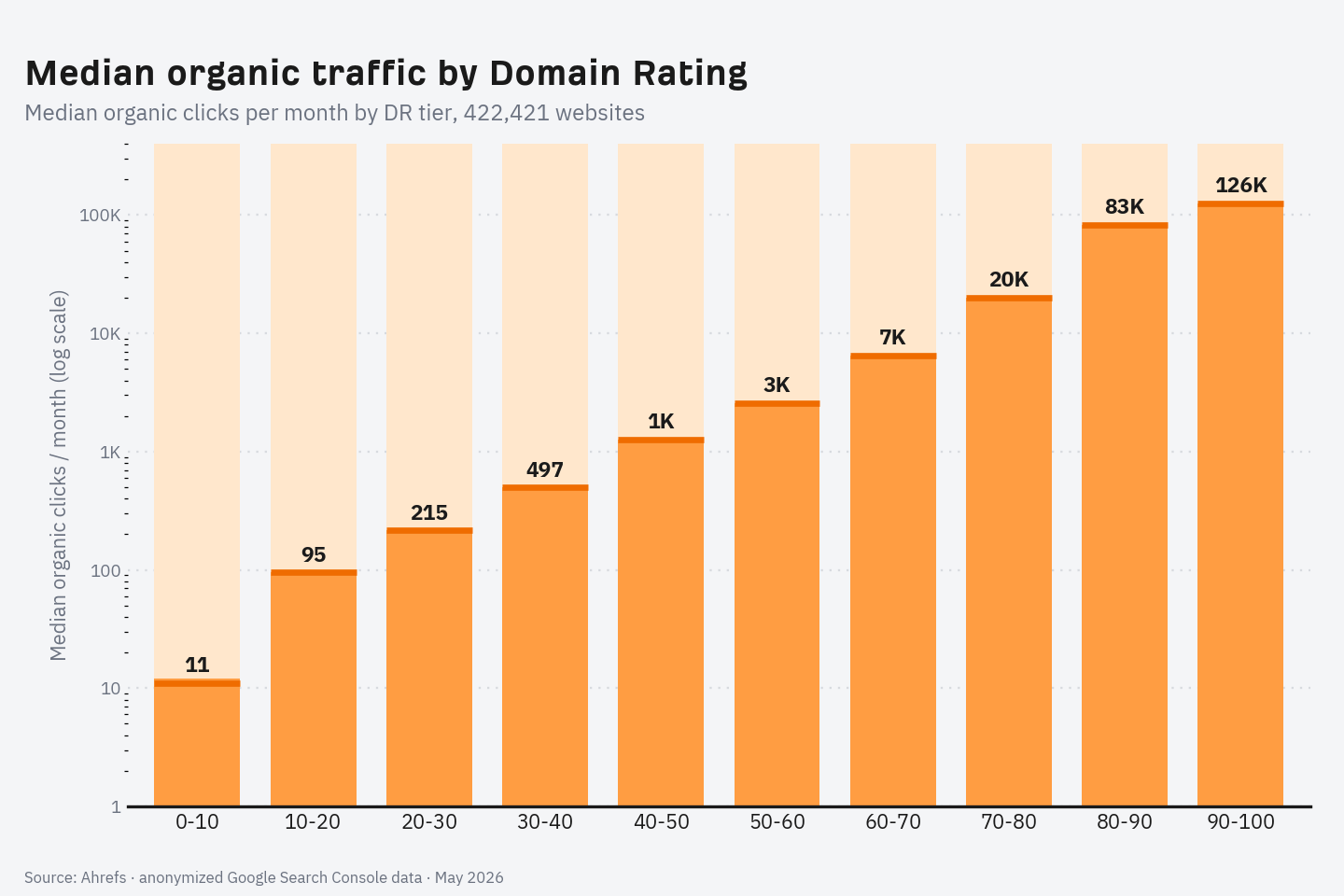
| Domain Rating | Median traffic | Mean traffic | Websites in sample |
|---|---|---|---|
| 0-10 | 11 | 378 | 217,565 |
| 10-20 | 95 | 1,501 | 59,960 |
| 20-30 | 215 | 3,541 | 51,139 |
| 30-40 | 497 | 7,473 | 38,447 |
| 40-50 | 1,264 | 28,181 | 21,499 |
| 50-60 | 2,567 | 48,933 | 15,575 |
| 60-70 | 6,527 | 120,217 | 8,344 |
| 70-80 | 19,980 | 279,757 | 7,858 |
| 80-90 | 82,743 | 1,249,038 | 1,614 |
| 90-100 | 126,364 | 8,401,539 | 420 |
To be clear about cause and effect: more backlinks don’t directly summon traffic. What’s happening is that the things that earn a high DR—lots of quality content, strong links, brand recognition—are the same things that earn rankings and clicks. DR is a proxy for the authority that wins traffic, not a dial you turn to get it.
The takeaway for newer sites: if you’re under DR 30 and getting a few hundred organic clicks a month, you’re not failing—you’re exactly where the data says you should be. Traffic compounds as authority builds, and the steepest gains come later, not sooner.
Similar Posts

The Coinbase Outage Was Our Warning…
Coinbase is not a place to hold crypto. It’s an exchange, not a wallet. And the outage…
AI Overviews Currently Appear for 83% of Branded Searches
That prompted us to investigate AI Overviews for branded searches on a larger scale. We found that…

Using Composer Path Repositories to Handle Module Dependencies During Development
Sometimes working on a Drupal contributed module requires making changes to the module’s composer.json so that you…

25 SEO Conferences to Attend in 2026
We’ve attended tons of SEO conferences and it’s still the best way to meet people in the…

The 2025 WooCommerce holiday gift guide
For the past four years, we’ve curated a gift guide to feature some awesome Woo stores, and…

I’ve Tested 35+ Crypto Hardware Wallets. Ask Me Anything
Buy Tangem (20% OFF + Free BTC): https://tangem.com/pricing/?promocode=CYBERSCRILLA&promocode=NYEXTRA26 Buy Trezor (Up to 20% OFF) : https://affil.trezor.io/aff_c?offer_id=369&aff_id=10648 Buy…