Your site can’t always rank for the keywords that would bring you the most customers.
Directories, review sites and big publishers often own page one, and it’s unlikely you’ll be able to outrank them any time soon.
But you can get your brand onto the pages that do rank.
That’s barnacle SEO, a tactic named in 2008 that sits uncomfortably close to parasite SEO, which Google penalizes.
So is it still smart marketing? I’d argue yes: done right, it gets your brand into SERPs and conversations that are hard to break into on your own—and now into AI answers too.
Below, I’ll cover what it is, where the risks lie, and how to do it the right way.
What is barnacle SEO (aka barnacle marketing)?
Barnacle SEO is the strategy of getting your brand featured on web pages that already rank, instead of relying only on your own site to climb its way to the top.
You can earn those spots through reviews, outreach and recommendations, or pay for them through ads, sponsored listings and paid directory profiles.
In barnacle SEO, the “whales” are high-authority sites like directories, review sites, forums and big publishers.
Say you’ve just launched a CRM.
You have no chance of ranking for “best CRM software” against the listicles and review sites already on page one.
But you can get featured on those listicles and reviewed on G2, which both show up for that search.
From there, anyone who searches that keyword can find you, even though your own site isn’t ranking.
That turns traditional keyword research upside down: instead of targeting the easiest keywords your own site can win, you purposefully target the hardest ones and win them on someone else’s page.
This strategy works best for small or new businesses, and for local ones competing with big directories.
Why barnacle SEO is still relevant in 2026
Barnacle SEO is still relevant because the pages that rank, and the AI answers built on them, mostly belong to other people.
But it does sit close to tactics Google penalizes, so it helps to know where the line is.
Here’s how they compare.
Barnacle SEO vs. parasite SEO vs. surround sound SEO—what’s the difference?
Barnacle SEO gets you a place on someone else’s page, parasite SEO publishes your own content on someone else’s site to rank it, and surround sound SEO is about filling up as much of one search results page as possible.
Alex Birkett and HubSpot’s team developed surround sound SEO around 2019, aiming to be mentioned on every page that ranks for their most valuable keyword—including rich SERP features, social profiles, forums and so on.
Further reading
Is barnacle SEO risky?
Barnacle SEO is fairly low risk because Google’s spam policies target pages and links made mainly to manipulate rankings.
A listing, review or mention on a page that already ranks doesn’t fit that description, since the page exists to help its readers and its owner chooses whether to include you.
The risk comes when brands cross the line into parasite SEO, which means publishing a brand-new page on a big site with intent to rank on that site’s authority, rather than helping its readers.
Google treats this as site reputation abuse, which is why CNN, USA Today and the LA Times saw whole sections of third-party coupon pages drop out of search results in 2024.
Their coupon pages had little to do with the news those sites are known for, so Google judged that they were borrowing the publishers’ reputations to rank, and demoted them.
It’s okay to pay for a barnacle SEO opportunity, but it comes with rules.
A paid spot in a genuine roundup is fine, and counts as advertising, as long as it’s disclosed to readers and any link is marked rel=”sponsored”.
That said, Lily Ray warns that listicle mentions sold quietly to sway SEO and AI answers are a growing risk.
Before you chase a placement, ask whether the page genuinely helps its readers and whether you’d deserve a spot there, paid or not.
If the answer is no, treat it as a risk.
Further reading
Earned “Barnacle SEO” mentions still pay off in 2026
Done the right way, barnacle SEO can get you into Google results and AI answers faster than ranking your own site.
For instance, up to 89% of the time, Ahrefs shows up in AI answers because other websites mention us.
Our study of 10,000 brands suggests this holds beyond Ahrefs, too, since every type of brand mention we measured, from Reddit threads and YouTube videos to news articles, correlated strongly with how often a brand appeared in ChatGPT, AI Mode and AI Overviews.
In other words, brands that other sites mention most also tend to get mentioned most in AI answers.
The rest of this guide covers how to earn get those mentions.
How to build a barnacle SEO strategy
A barnacle SEO strategy comes down to finding the pages that rank for searches you can’t win, working your brand into them, and then promoting the pages you’re on.
You can find host pages by hand in Google, but Ahrefs helps you scale it across hundreds of keywords at once.
Step 1. Pick the searches you can’t win yourself
Barnacle SEO works best on keywords that are valuable to your business but too hard for your site to rank for.
It makes sense to focus on high search volume keywords, so you can get as many eyes on your business as possible.
Keyword Difficulty (KD) is also a handy metric for spotting which keywords are out of reach.
It’s a 0–100 score that estimates how hard it is to rank in the top 10 for a keyword, based on how many websites link to the pages that currently rank.
For example, the keyword “CRM software” has a “Super hard” KD of 72, meaning a page would need links from around 224 websites to crack the top 10.
That’s why its first page is held by high-authority sites like Salesforce, HubSpot, monday.com, and Forbes, most with a Domain Rating (DR) above 90—as you can see in the SERP Overview report via Keywords Explorer below.
This keyword is also searched around 770K times a month in the US, so there’s a big audience behind that difficulty.
But only some sites on this SERP make good barnacle SEO opportunities.
I’ve highlighted them above: PCMag, G2, the US Chamber of Commerce and Forbes.
They review and rank CRM tools without selling one, so you have a real chance of getting featured.
The rest, like Salesforce, HubSpot, monday.com and Creatio, are CRM vendors whose roundups exist to promote their own product, so they’re unlikely to feature a competitor.
“CRM software” is hard to rank for, has plenty of search demand and has a few solid barnacle SEO opportunities, so it seems to tick every box.
To find more keywords like this, open Keywords Explorer, enter your keyword, head to the Matching Terms report, make sure you’ve sorted by search volume high > low, and set the KD filter to 50 or more.
Then cherry-pick the keywords that are
-
Most relevant to your goal
-
Most likely to mention products, features or services
To expand that keyword list further, you can also run a keyword gap analysis with Content Gap.
Enter two or three competitors to see the keywords they rank for and you don’t.
If they’re relevant, add them to your list.
These are your barnacle targets, and in Step 2 you’ll find the sites ranking in the top positions for them.
Step 2. Find the barnacle SEO sites that dominate search and AI answers
With your target keywords picked, it’s time to find the sites that already win them, in both Google and AI answers.
These are the pages you want your brand visible on.
Start with your most important keywords.
This shows you which sites have the biggest share of organic search traffic for those keywords.
Skip any competitors, since they won’t feature you.
Among the rest, you’ll usually find three types of barnacle SEO opportunity:
-
UGC platforms: Threads and discussions on sites like Reddit that already rank for your keywords, where you can add a genuinely helpful answer.
-
Review sites and niche blogs: Review profiles and category pages on sites like G2, plus independent “best CRM” roundups that already rank.
-
Publishers: Existing “best X” roundups on media sites like PCMag and Forbes, which you can ask to be added to at their next update.
Want a head start? The Barnacle SEO Finder below covers certain categories where barnacle SEO works well.
For each one, we checked the top 10 for 30 hard-to-rank searches and sorted the genuine opportunities by type.
Step 4 covers how to get onto each type of page in more detail.
Check the pages AI assistants cite too
AI answers often cite different pages from the ones that rank, so check those for barnacle SEO opportunities too.
In Brand Radar, open the “Cited pages” report and switch to the “Other” tab to see the third-party pages AI assistants cite for your topic.
You may also want to exclude pages you’re already mentioned on, and filter to just focus on articles rather than product landing pages or general site pages.
From there, you can add some of the most cited barnacle SEO opportunities to your host page list.
Pages that already mention your competitors (see the “Mentions on page” column) may be quicker wins, since they’ve shown they’re willing to cover brands like yours.
Step 3. Check each host page’s estimated traffic
A mention on another webpage only helps you if people read it, so check its estimated traffic before you pitch for inclusion.
Paste the URL into Site Explorer, set the mode to “Exact URL” and open the “Traffic sources” report in Traffic Analytics, which estimates visits from every channel, including direct, referral and AI.
Zapier’s “best CRM app” roundup, for example, got an estimated 6,300 visits in the last 30 days, with a third coming from direct and referral traffic.
That makes it a strong barnacle SEO host, since it’s estimated to get thousands of visits a month, and a third of them come from outside Google, so a listing there doesn’t depend on its rankings alone.
Prioritize roundups, directories and review pages with steady estimated traffic.
Step 4. Get your brand onto each host page
Before you start, be clear on what counts as barnacle SEO, so you don’t stray into riskier tactics like parasite SEO.
Barnacle SEO: Getting a slot on a page or feature that already ranks or gets cited, like a directory listing, a review site profile, a spot in the map pack, a place on a “best X” list or a reply in a ranking Reddit thread. Many profiles exist whether you claim them or not, so claiming one just puts you in control of a slot that’s already there. You can earn these slots or pay for them.
Not barnacle SEO: Creating a brand-new page on someone else’s site, like a guest post or sponsored article. That counts as content marketing or PR, as long as the site publishes it as genuine content for its readers. If the page is there mainly to borrow the site’s rankings, it’s parasite SEO, which Google penalizes.
How you get onto a page depends on what kind of page it is.
Claim your profiles on review sites and directories
Your profiles on review sites and directories are the easiest wins, because they can help you show up in two ways.
-
Listings pages
Review sites give every product its own listing page, and these often rank when people search for reviews of a specific brand.
-
Category pages
Review sites also publish category pages, which rank all the products in a category using the reviews and details from each profile.
G2, for example, has a category page on the best content marketing software, which ranks in position 2.
Get added to “best X” lists
“Best X” lists are some of the most valuable host pages to get onto.
Their keywords, like “best CRM software”, tick every box for a barnacle SEO target, and according to Glen Allsopp, they’re also the most frequently cited page type in ChatGPT.
Authors only add products that improve their list, so give them a reason to include you, like a feature none of the current picks offer or free access so they can test it themselves.
And bear in mind that many lists are updated yearly, so ask to be included in the next revision rather than requesting an edit straight away.
You should also watch out for two pitfalls:
-
Self-promotional lists are under growing scrutiny. Lists where a brand ranks itself first may be on Google’s radar, according to Lily Ray, and our own experiment found they can backfire in AI answers. One tactic here may be to prioritize lists on sites that don’t sell what they rank.
-
Free placements are hard to come by. Getting listed for free is “very, very hard”, according to our CMO Tim Soulo, so expect many sites to ask for a fee or an affiliate commission. That’s fine, as long as the placement is disclosed and any paid links are marked
rel="sponsored".
Get listed in local directories
If you’re a local business, from a single plumber to a chain with dozens of locations, your main host pages are your Google Business Profile, which appears in the map pack, and the directories that rank for your services in your area, like Yelp, Zocdoc or Avvo.
Our local citations guide covers how to claim them. You can also earn spots on other local pages by joining your chamber of commerce or entering your local newspaper’s “best of” awards.
Join conversations on Reddit
One of the best things about barnacle SEO is that the same host page can work for you twice: once in Google’s results, and again when AI assistants cite it.
Reddit is one of the clearest examples of a host site that gets ranked in the SERPs and retrieved by AI.
It was the strongest correlation of any mention type in that study.
So a genuine presence on Reddit can reach a huge audience, from Google to ChatGPT, AI Overviews, Perplexity and beyond.
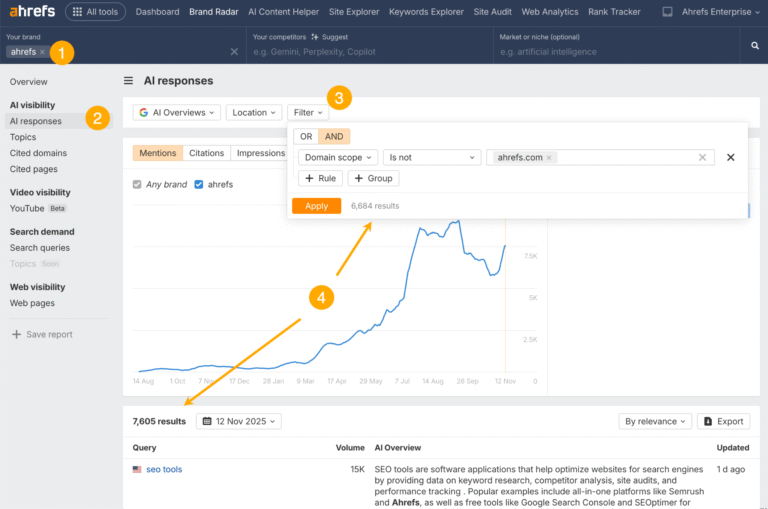
To see which threads AI assistants already cite for your category, filter the “Cited pages” report in Brand Radar by the reddit.com domain.
In November 2026, Reddit began rolling out Reddit Reviews, which uses AI to turn product conversations into dedicated review pages.
You can’t claim or pay for one—what users say is all that counts.
But you can check whether your product, or your competitors’, has a review page, and note what people praise and complain about.
Then join the threads it links to and address any recurring complaints.
Our Reddit SEO guide covers how to join those threads without coming across as spammy, starting with being upfront that you work for the brand.
Further reading
Step 5. Promote and optimize your barnacle SEO efforts
Barnacle SEO gets you onto powerful pages where new audiences can find you.
But don’t just claim your spot and move on: treat those pages as assets you can help grow.
Share each new placement on your social accounts
When you land a new placement, share it on social and link to the host page.
Zoho UK did this on LinkedIn, when PCMag named Zoho CRM its Editors’ Choice.
It linked straight to PCMag’s roundup, one of the top-ranking pages for “CRM software” we saw in Step 1.
Link to your placements from your own site
People on your site are often still weighing you up, so point them to your strongest barnacle SEO placements on a page like “Featured in” or “Reviews”.
That way, each placement works twice: it reassures buyers on your own site, and sends more readers to the host page that features you.
For example, our own reviews page shows our ratings on Capterra, G2, TrustRadius and Crozdesk, each linking back to the review site.
Feature your placements in your own content
Turn your best reviews, badges and roundup mentions into content—from blog posts to sales emails and newsletters—so a single placement keeps reaching new people long after it goes live.
UK CRM provider Workbooks, for example, turned a G2 badge into a blog post.
Keep incentivizing reviews
Reviews help decide where you appear on review sites’ category pages and whether you earn badges.
So ask every customer for one at the same point, like right after a purchase, with a direct link to your profile.
UK retailer AO.com, for example, invites every customer to review it on Trustpilot after their order, and has collected around 197,000 reviews in the last 12 months.
Once you’re on a page, keep your entry up to date.
Step 6. Measure your barnacle SEO results
Your results depend on someone else’s page staying where it is, so keep a simple list of the key pages you’re mentioned on and the keyword each one ranks for.
Then check these each month:
-
Referral traffic from each host page, in Web Analytics, which counts real visits to your site rather than estimating them. For placements that link to you, it’s the most direct proof they’re working, and it shows which hosts are worth more of your effort. Unlinked mentions won’t show up here, so judge those by the other metrics below. Drop hosts that never send visitors, and put more effort into the types of page that do.
-
Rankings for the host pages, in Rank Tracker. Your visibility only lasts as long as the pages you’re on keep ranking, so if a host page slips, your exposure slips with it. Tracking those pages lets you know when it may be time to find a replacement.
-
AI citations of the host pages you’re on, in Brand Radar. This is the closest you’ll get to measuring barnacle SEO’s impact on AI: if those pages keep getting cited, your placements are still feeding the answers people see. Just create a “Watch list” in the Cited Pages report to zero in on your barnacle SEO articles.
-
AI mentions of your brand over time, also in Brand Radar. Mentions aren’t always caused by citations, so you can’t pin them on any one barnacle SEO placement, but a steady growth in mentions is a good sign your overall presence is working.
Track lost barnacle SEO placements
Pages also change without warning, and a host can remove you from a list at any time.
Use a monitoring tool like Firehose to hear when your brand disappears from a page you rely on.
Because the whole process can be described in plain language, an AI agent can run it for you.
I built mine as a workflow in Letaido: I described the barnacle SEO placement I wanted to track, gave it the URL, and Letaido handled the rest.
I’m now tracking one of the most-cited “best AI visibility tools” lists that recommends Ahrefs.
If that mention ever gets dropped, I’ll know straight away, and that’s my cue to start the next round of barnacle SEO outreach.
Final thoughts
Barnacle SEO lets a small or new brand show up for searches it could never rank for on its own.
It stays low risk as long as you earn your spots or pay for them openly, on pages that genuinely help their readers.
Get that right, and every placement can keep working for you in Google and in AI answers long after you’ve secured it.