Content that stays current stays visible. Your content’s publish date can be a competitive advantage or a liability.
Fresh content or content freshness simply means how new or recently updated a page is. Keeping your content up to date tells Google and AI assistants that your information is current, helpful, and reliable, which helps you keep good rankings and earn more mentions.
As search engines and AI assistants continue to prioritize recent information, regularly updating your content has become one of the easiest and most effective ways to stay visible and competitive.
In this article, you’ll learn why fresh content matters for rankings and AI citations, which types of content need the most frequent updates, and how to systematically identify and refresh your outdated pages for maximum impact.
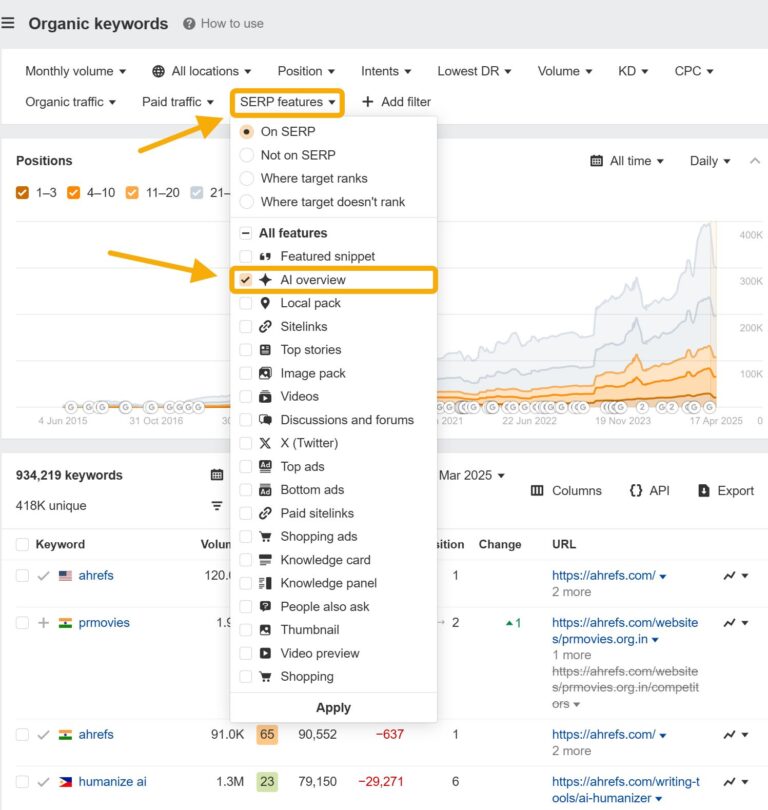
Query Deserves Freshness (QDF) algorithm detects that a topic needs current information, it boosts recently updated pages.
Certain search queries semantically signal the need for fresh content—terms like “new iPhone,” “latest news,” or “2025 trends” make it clear users want current information. But for others, the QDF algorithm looks for three signals that a topic is “hot”:
- News sites are actively writing about it.
- Blog posts are covering it frequently.
- Search volume is spiking.
When all three occur, Google prioritizes fresh content to give searchers the most current information.
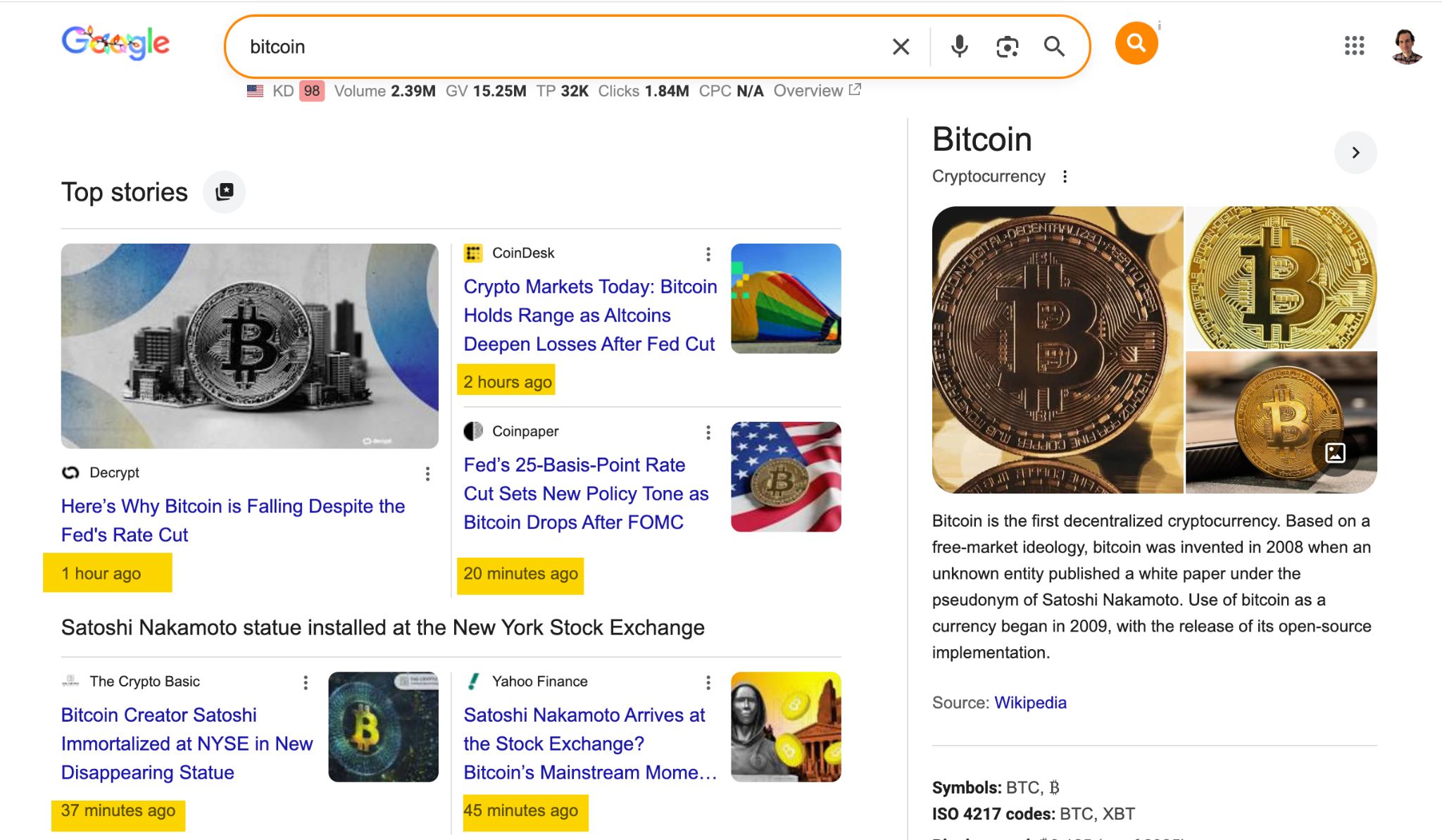
According to Google’s documentation, a SERP may gain or lose this feature based on the circumstances.
Fresh content gets higher click-through rates
Users naturally prefer recent content. An outdated title like “Best CRM Tools 2023” gets fewer clicks than “Best CRM Tools 2025”—even at the same ranking position—because users assume older content contains obsolete information or outdated recommendations.
Research shows Google uses click-through rate when re-ranking content. Lower clicks from stale titles create a downward ranking spiral over time.
Fresh content prevents ranking decay
Even when QDF isn’t triggered, Google favors pages that show active maintenance signals.
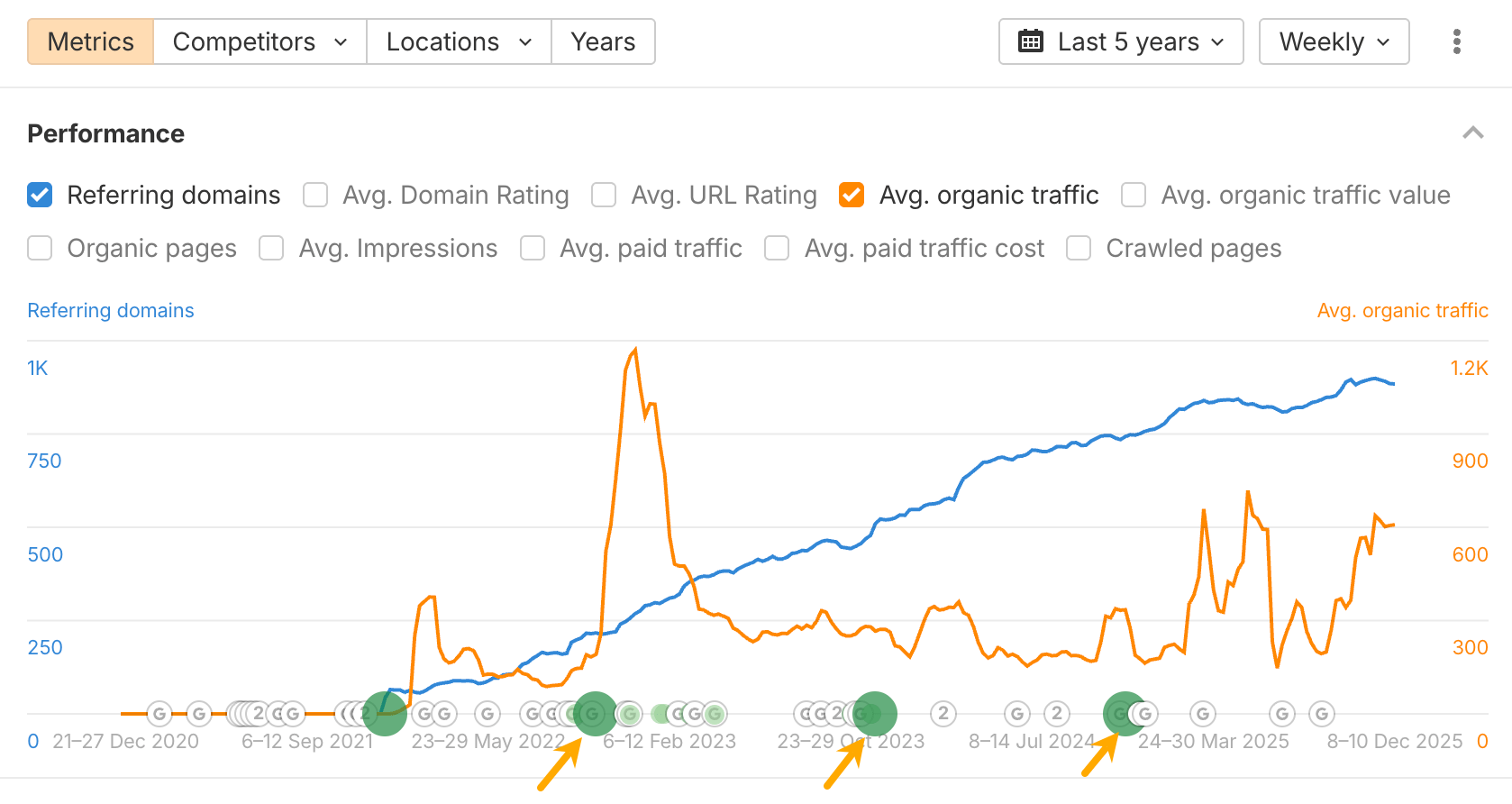
For example, my content marketing statistics article gains more traffic and gets a boost in referring domains each time it’s updated, but requires regular refreshes to maintain performance.
Fresh content increases your chances for AI citations
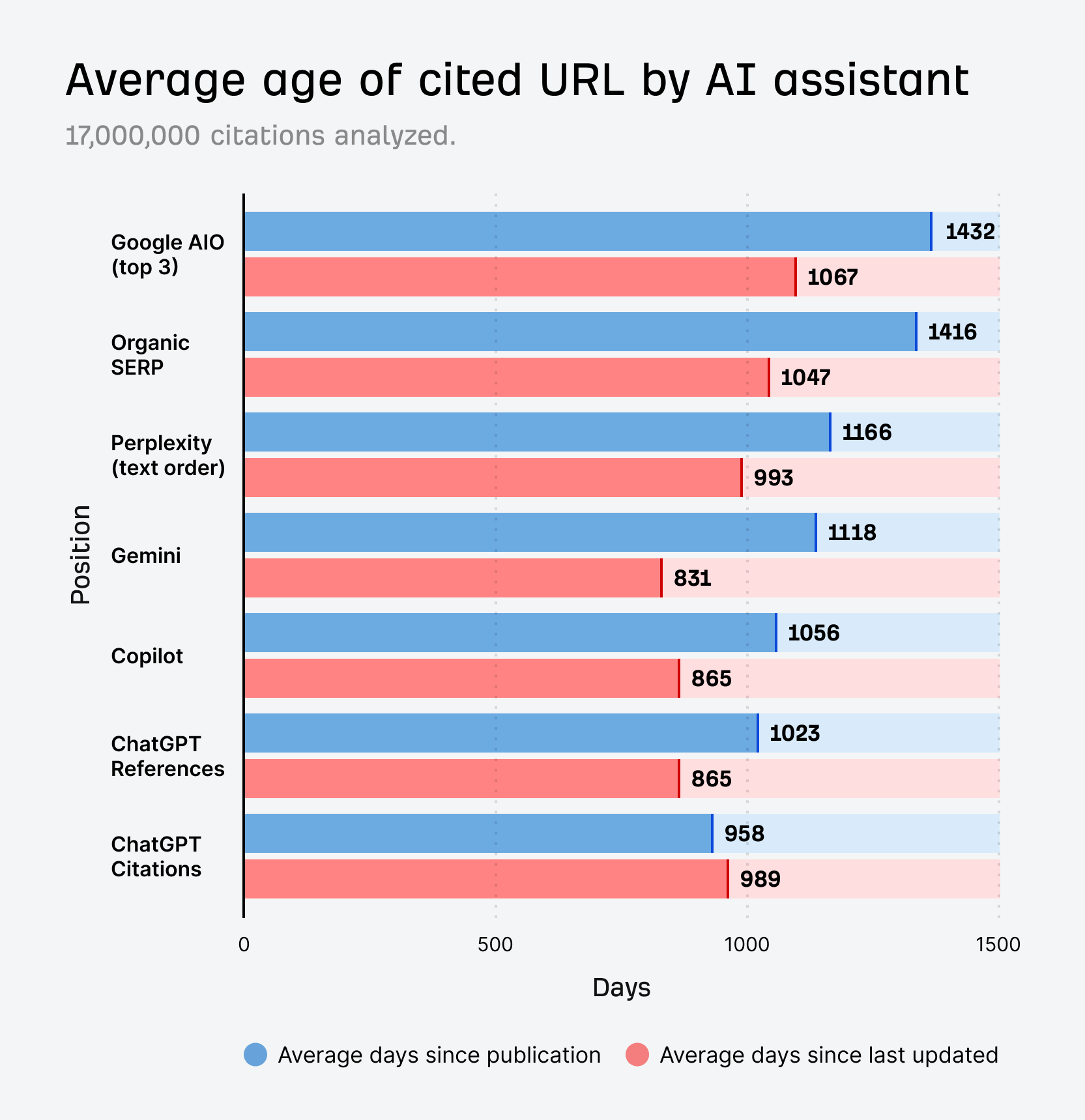
AI assistants cite significantly fresher content than traditional search results. Ahrefs’ study analyzing 17 million citations found that AI-cited content is 25.7% fresher than organic Google results.

Breaking it down by platform:
- ChatGPT shows the strongest preference for new content, citing URLs that are 393-458 days newer than organic Google results.
- Perplexity and Gemini also favor fresher content.
- Google’s AI Overviews behave most like traditional search, actually citing content that’s slightly older than what ChatGPT prefers.
Ahrefs’ Webmaster Tools (a free toolkit that gives you access to Site Audit and other features) or Screaming Frog. You’ll just need two things: the date format the site uses in its code, and the regex pattern to match it. Let’s start by finding the code.
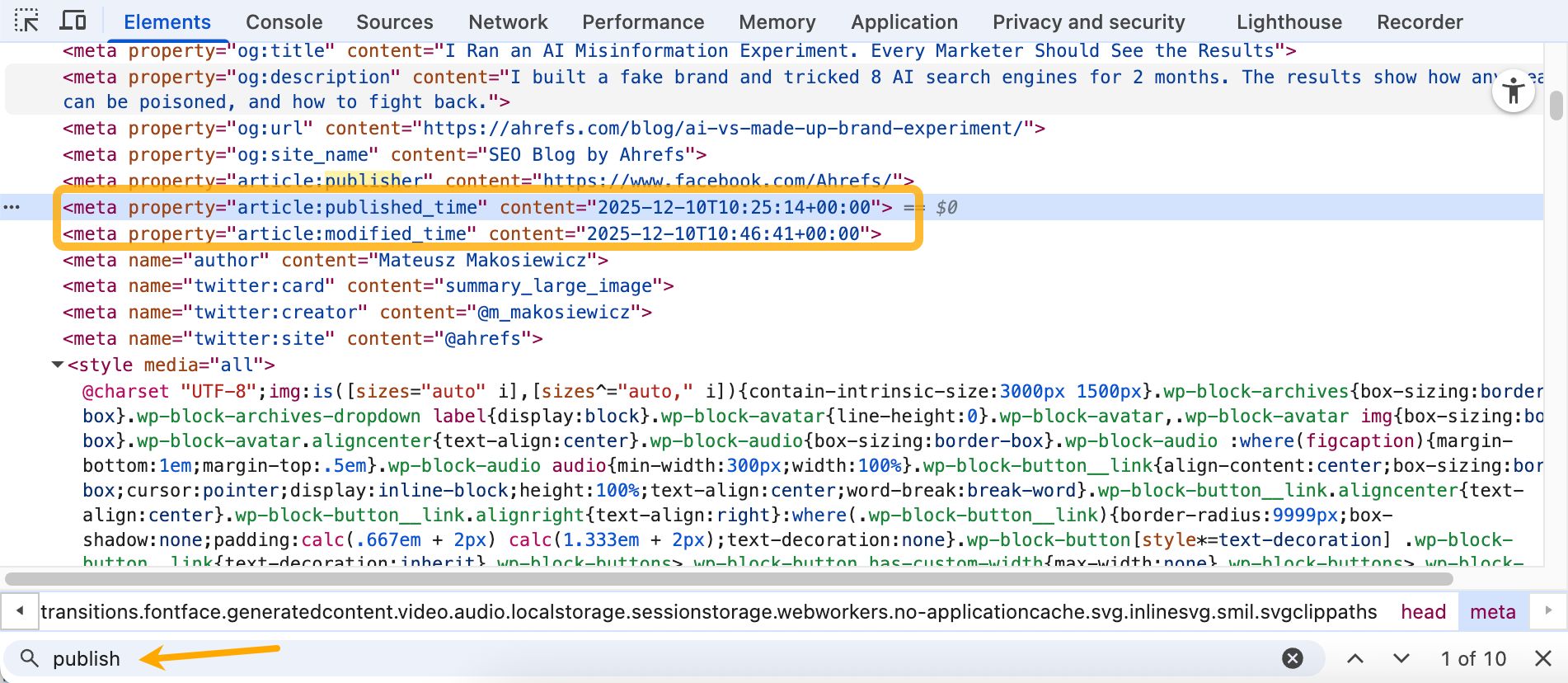
Open any blog post on your site that you’ve updated. Then open Inspect (Developer Tools) and, in the search bar, type “publish”.
Write down the properties that hold the published date/time and the last updated date/time.
Now you’ll need two regex patterns. You can adjust the dates as needed and add the codes you found earlier—just ask any AI assistant to help you with that.
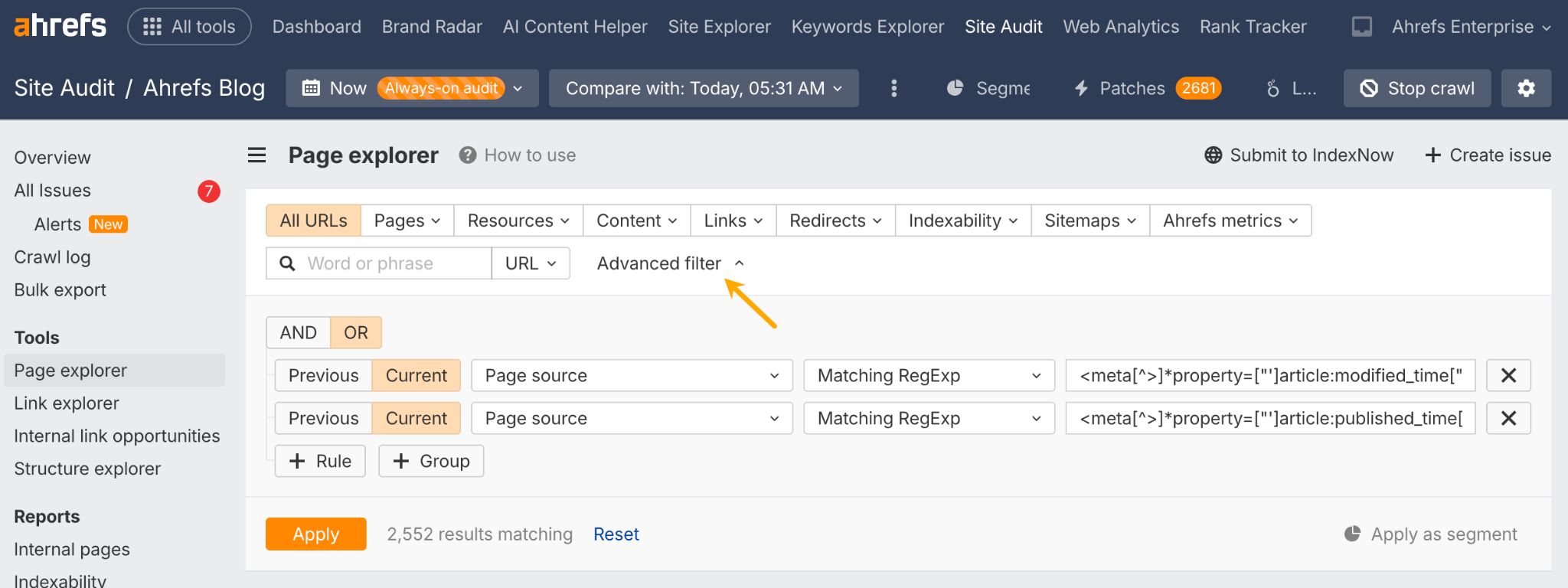
Here’s the regex to find content that has never been updated since publication:
<meta[^>]*property=["']article:published_time["'][^>]*content=["'](?:20(?:0d|1d|2[0-4])-d{2}-d{2}|2025-(?:0[1-5])-d{2})T
And this regex is to find content last updated before a certain date:
<meta[^>]*property=["']article:modified_time["'][^>]*content=["'](?:20(?:0d|1d|2[0-4])-d{2}-d{2}|2025-(?:0[1-5])-d{2})T
Combine these filters like this (I’m using Site Audit here, included in Ahrefs Webmaster Tools):
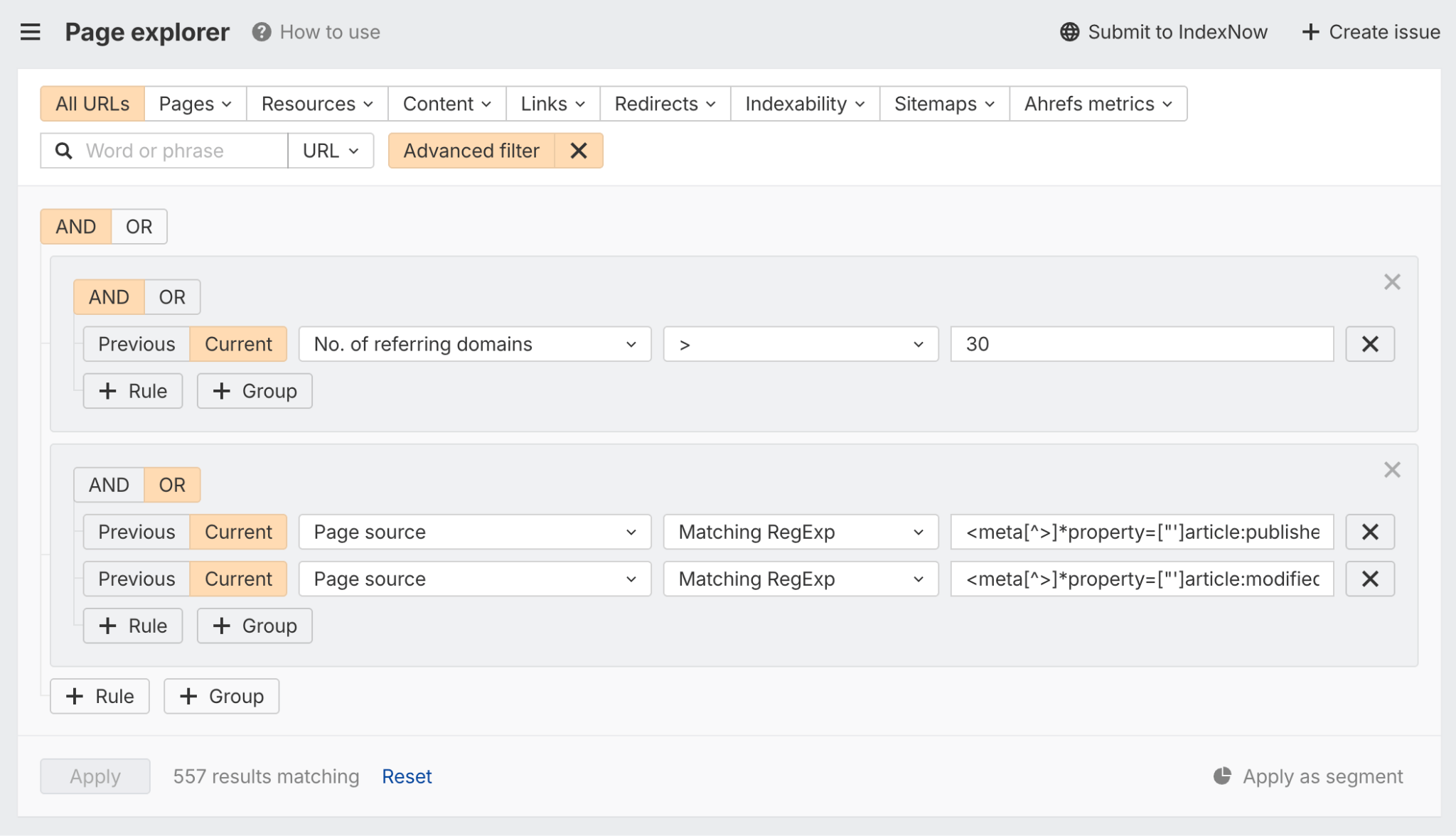
You can also include referring domains to help you prioritize pages that already have some authority, so updates are more likely to show results faster.
Recommendation
To automate this even further, you can enhance the data with traffic opportunity gap insights using the Ahrefs API or MCP.
You can also “guess” each page’s main keyword by pulling it from the URL structure. It’s not perfect, but it works well at scale.
Ask your favorite AI assistant to build a small Python app to handle this. Here’s a sample prompt you can use:
Create a Python script that analyzes content performance and identifies articles that need updating based on their traffic gap.

Requirements:

The script should:
 1. Accept a list of URLs as input (either from a CSV file or as a list in the code)
 2. For each URL:
    - Extract the target keyword from the last segment of the URL slug (the part after the final slash, removing hyphens and converting to a search-friendly format)
    - Use the Ahrefs API to fetch the page's current estimated organic traffic
    - Use the Ahrefs API to fetch the global search volume for the extracted keyword
    - Calculate the "traffic gap" = (Global Search Volume - Current Organic Traffic)
 3. Output a prioritized list showing:
    - URL
    - Extracted keyword
    - Current organic traffic
    - Global search volume
    - Traffic gap
    - Priority ranking (sorted by largest gap first)
 4. Export results to a CSV file with all the above columns

Technical specifications:
 - Use the Ahrefs API endpoints for:
    - site-explorer/organic-keywords or site-explorer/metrics to get organic traffic for each URL
    - keywords-explorer/overview to get global search volume for keywords
 - Refer to the Ahrefs API documentation for endpoint details and parameters: https://docs.ahrefs.com/docs/api/reference/introduction
 - Handle API rate limiting appropriately
 - Include error handling for URLs that don't return data
 - The keyword extraction should handle common URL patterns (removing hyphens, handling special characters)

Please provide well-commented code with clear variable names and include instructions for setting up the Ahrefs API credentials.
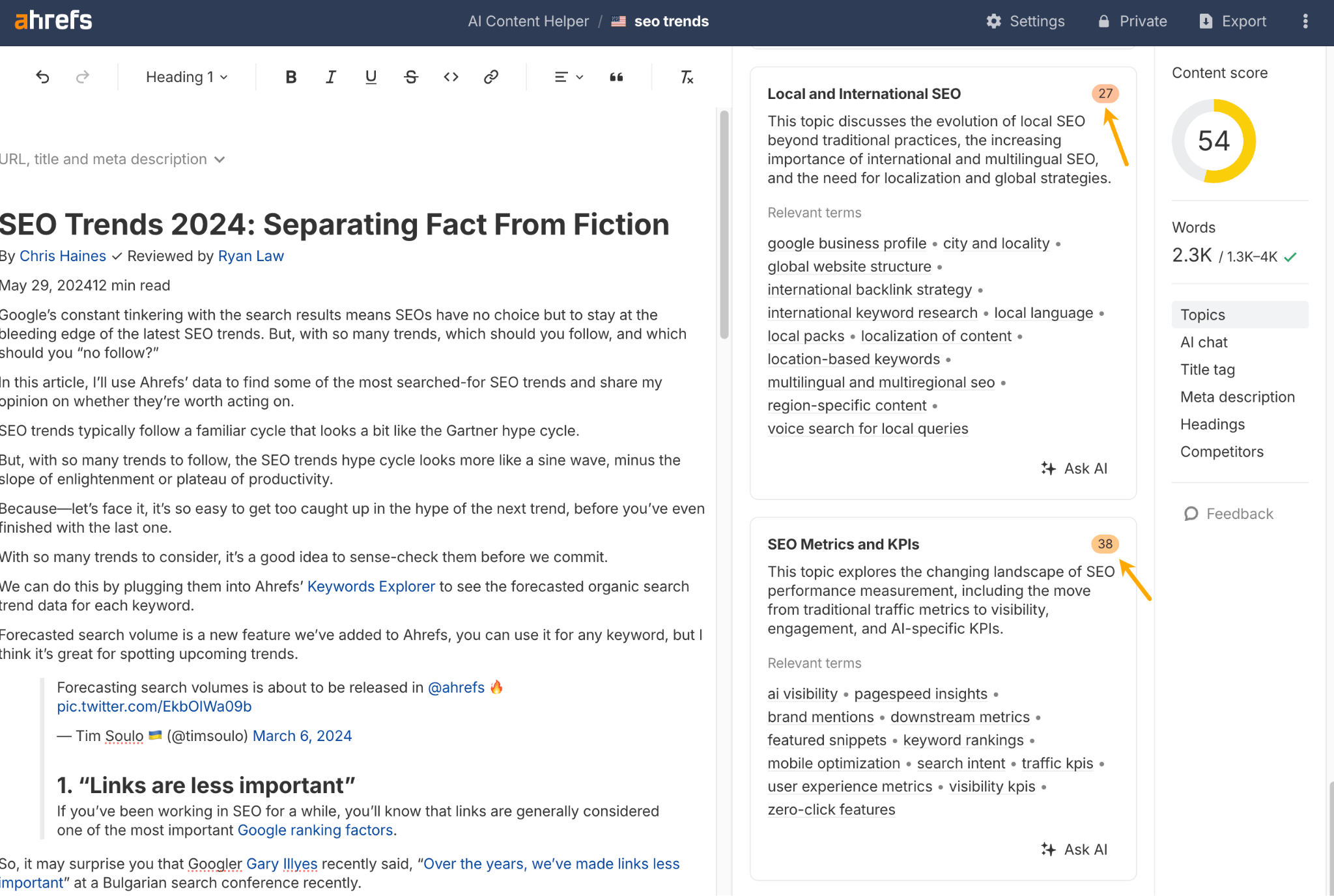
Ahrefs’ AI Content Helper. It uses AI to spot topical gaps automatically, showing which topics you’re missing and scoring your coverage against the pages that rank at the top.
Swap stale stats for current data
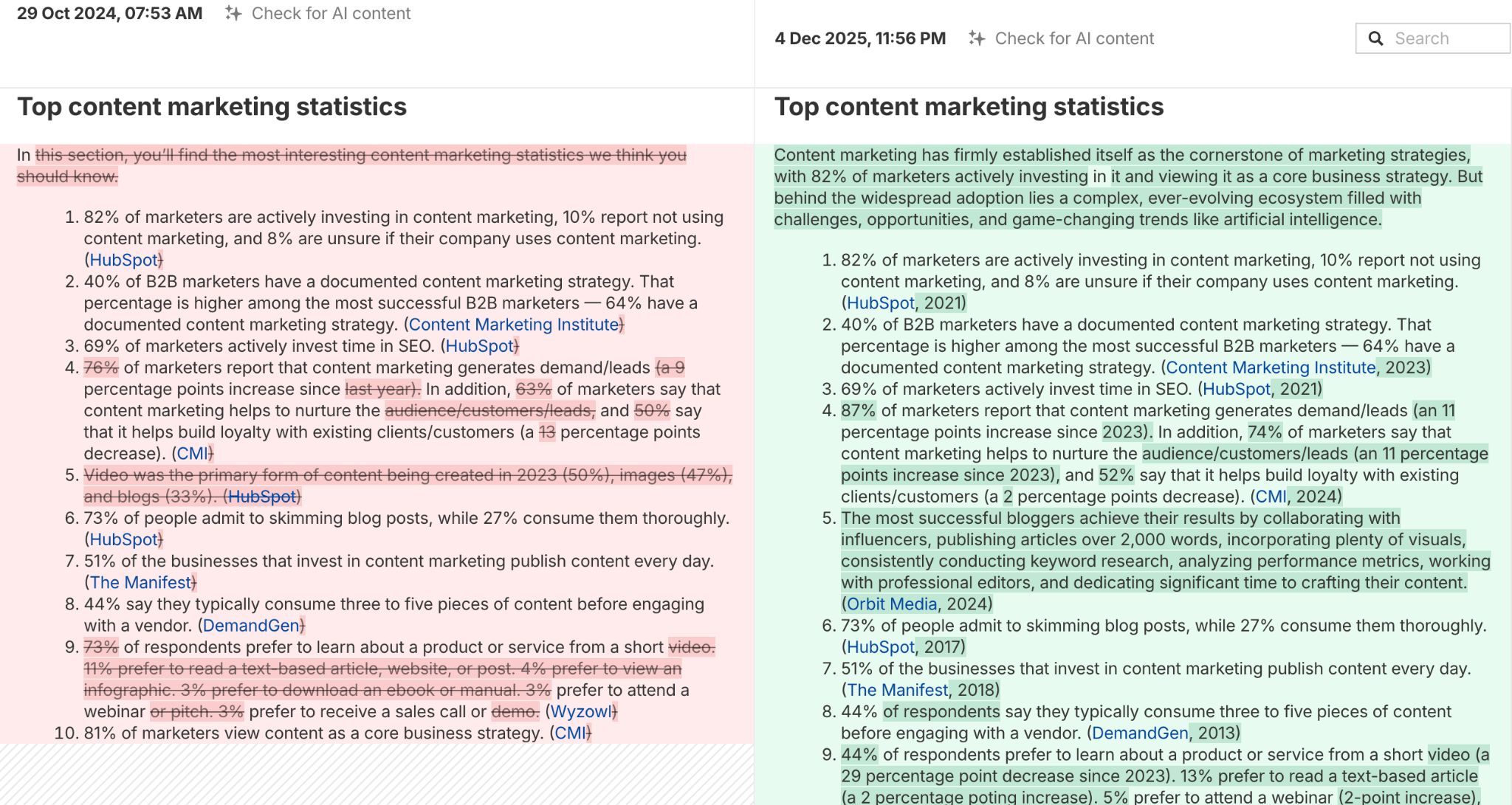
Old statistics undermine your credibility and can signal to search engines that your content is outdated.
- Replace outdated statistics with recent ones. Add new ones that add something to the topic.
- Update pricing information.
- Add “as of [Month Year]” to key facts.
- Link to recent, authoritative sources instead of outdated ones.
That’s exactly what my colleagues and I do with our curated statistics articles (page comparison via Ahrefs’ Site Explorer):
Refresh product details to boost user engagement
I’d say this tip is mainly about improving click-through rates and on-page user signals. You can apply it alongside other improvements, or even use it to refresh content that’s already ranking in the top 10 by highlighting new updates or features in your product.
- Replace screenshots showing old interfaces.
- Cover recent developments in your topic.
- Remove discontinued products or services.
- Address new objections or concerns that have emerged.
Target seasonal freshness windows
For recurring topics like the ones below, update 3 months before peak season:
- “Black Friday deals”. Update August/September.
- “Tax tips”. Update November/December.
- “Summer destinations”. Update January/February.
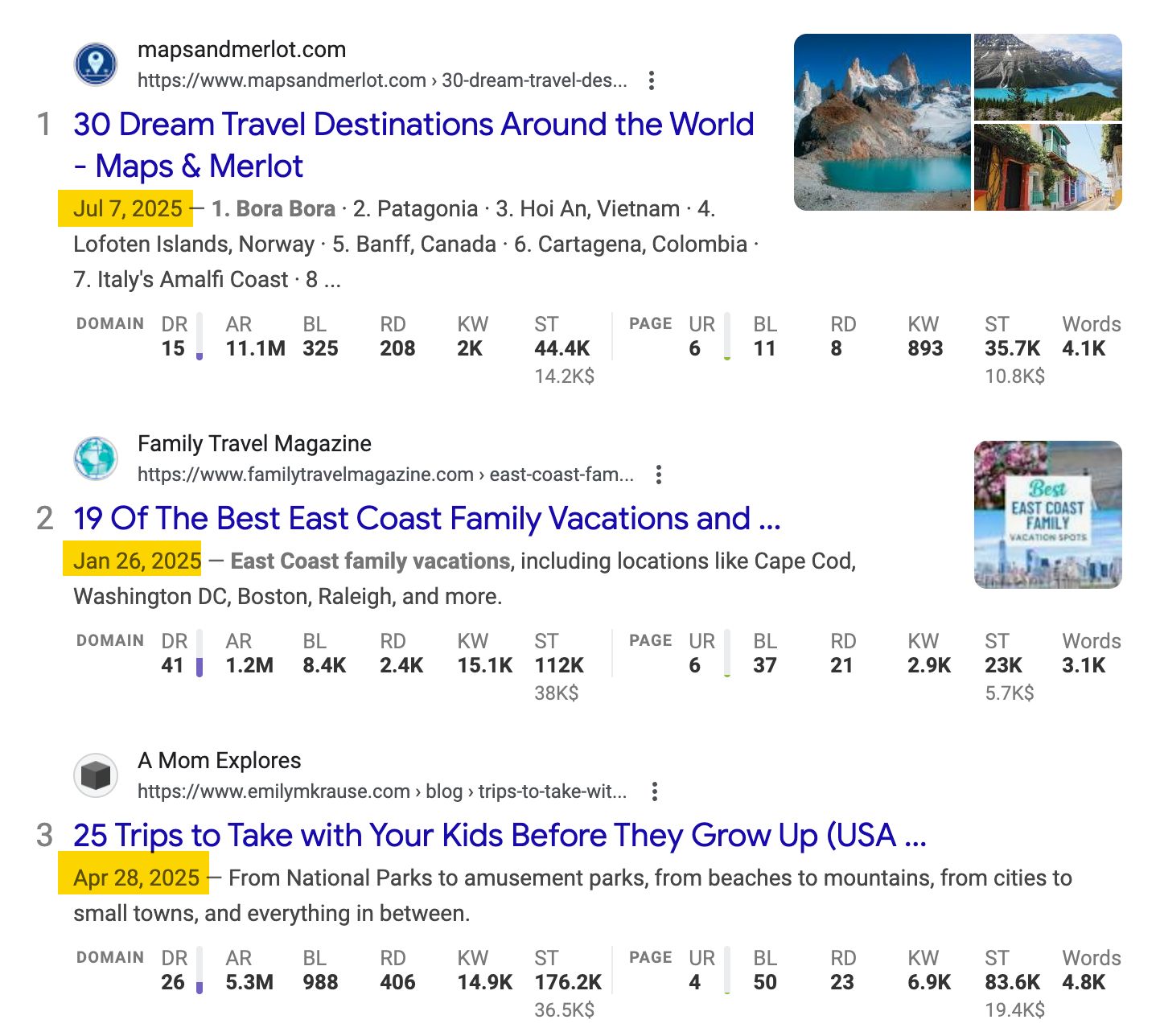
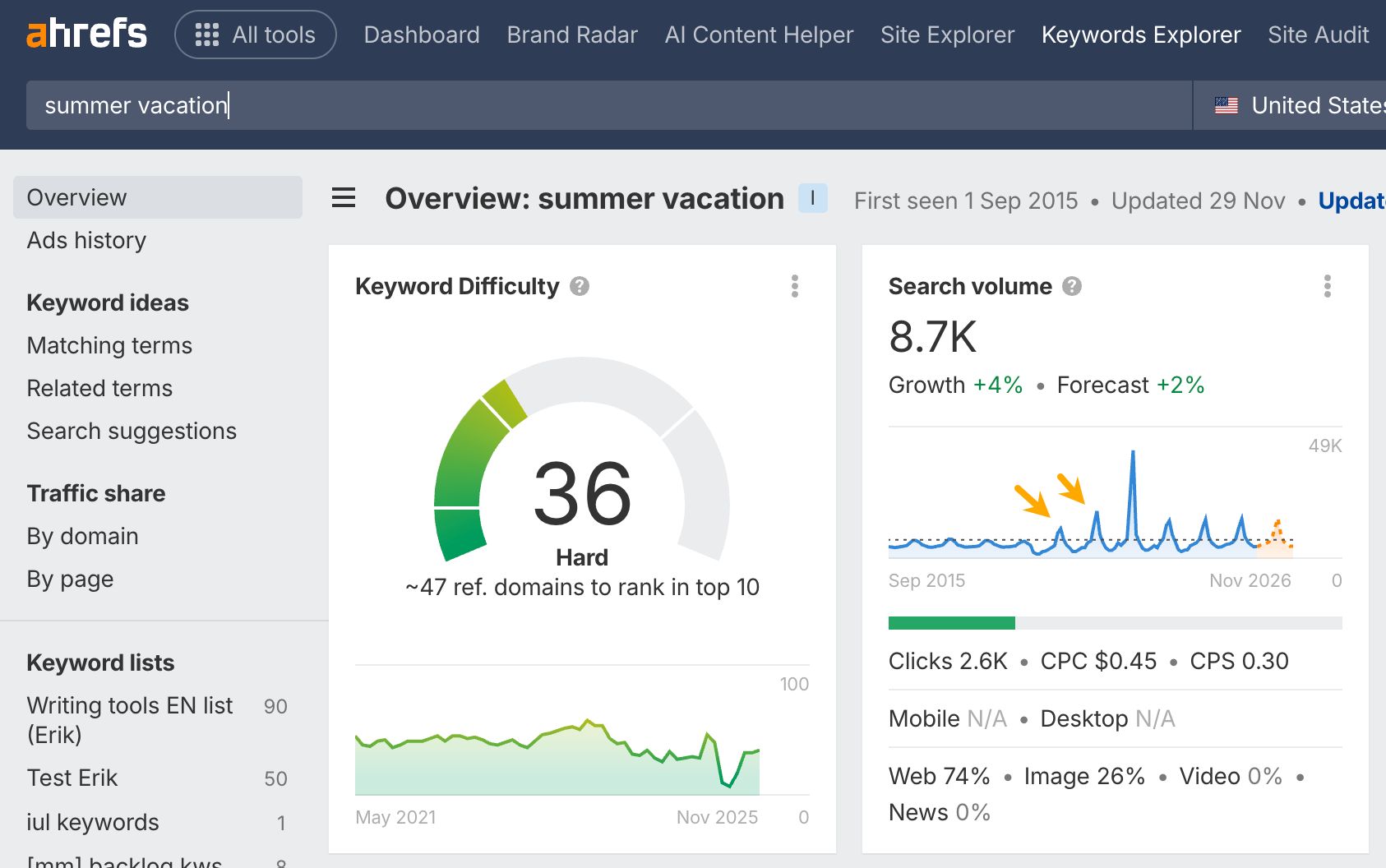
Google’s QDF algorithm anticipates these search patterns and favors content that is updated at the right time. For example, pages ranking at the top for “summer holiday” in December 2025 were last updated in early 2025 to target early planners, and again around July 2025 to reach late planners. After summer, those pages typically aren’t updated again for the rest of the year.
As you can see below in the search volume history for the keyword (via Keywords Explorer), this content creation pattern closely follows when interest in the topic rises.
Promote your refresh to earn fresh backlinks and more visitors
You don’t have to stop at republishing the content. You can also promote it on social media, support it with paid ads, or repurpose it into a webinar or other formats. This increases your chances of earning backlinks and attracting more traffic and new visitors.
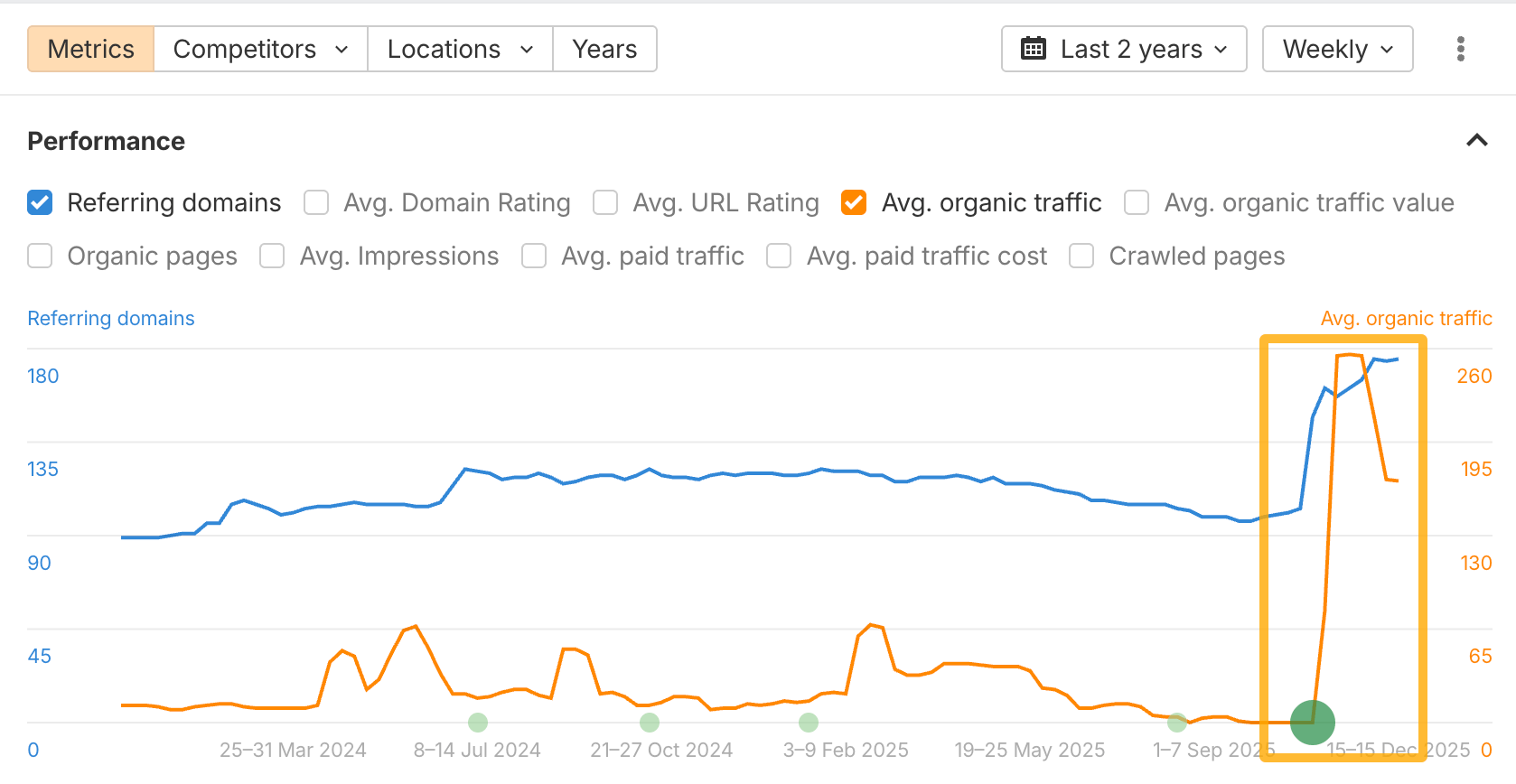
This is exactly what my colleague Louise did with a content refresh, gaining not only more traffic but also new referring domains and viewers through a webinar on YouTube.
Signal freshness where it counts
Make your updates visible to both users and search engines:
- Add “Last Updated: [Date]” at the very top
- Update the year in your title if appropriate: “Best Project Management Tools 2025”
- Change dateModified in your schema markup
- Consider adding a brief note explaining what was updated and why
Add internal links while you’re updating
Content refreshes are the perfect time to strengthen your internal linking. Use Site Audit’s Internal link opportunities tool to find relevant pages on your site that should link to the content you’re updating. The tool takes the top 10 keywords (by traffic) for each crawled page, then looks for mentions of those on your other crawled pages.
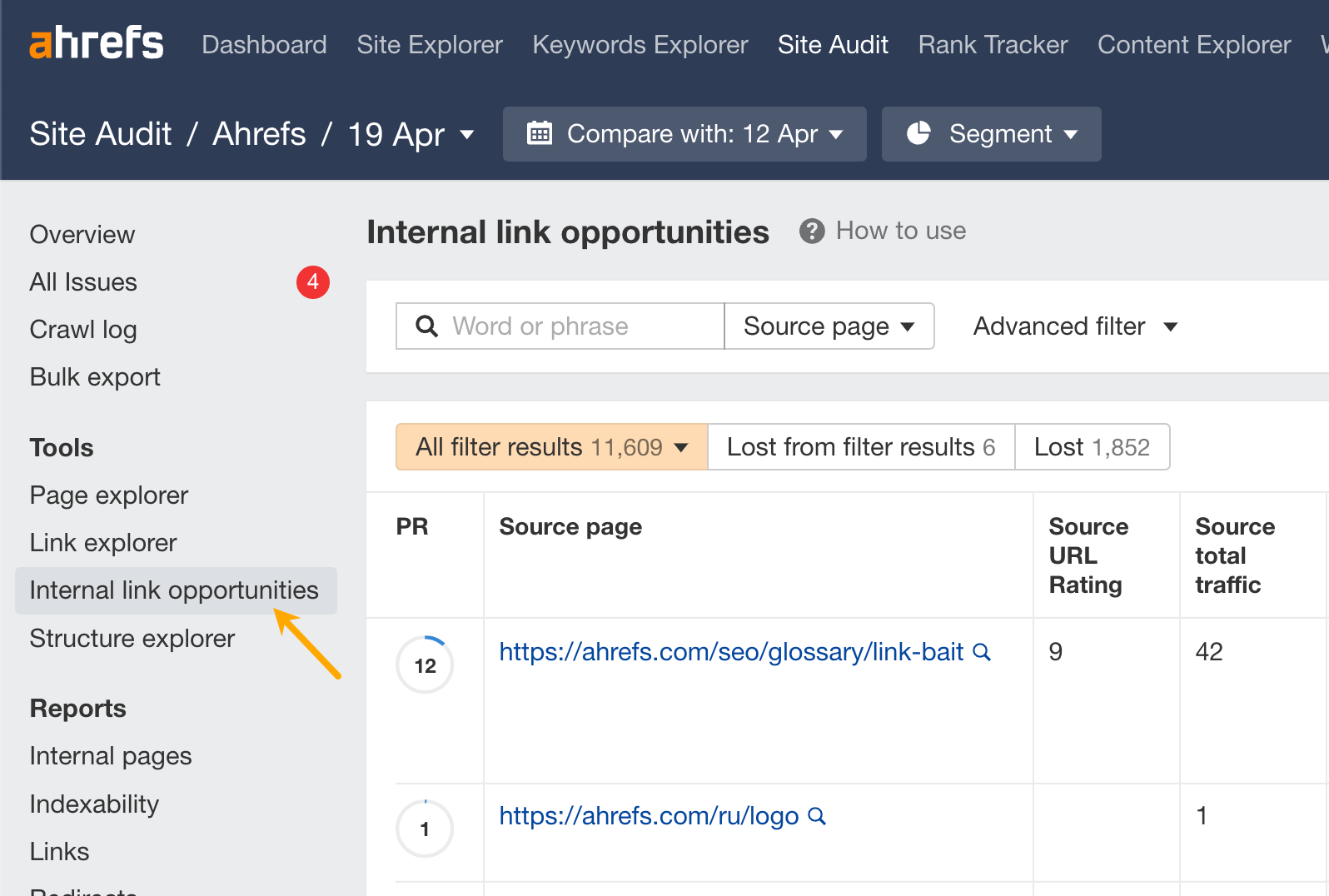
This helps distribute authority and makes it easier for users to discover related content.
Use IndexNow for instant indexing
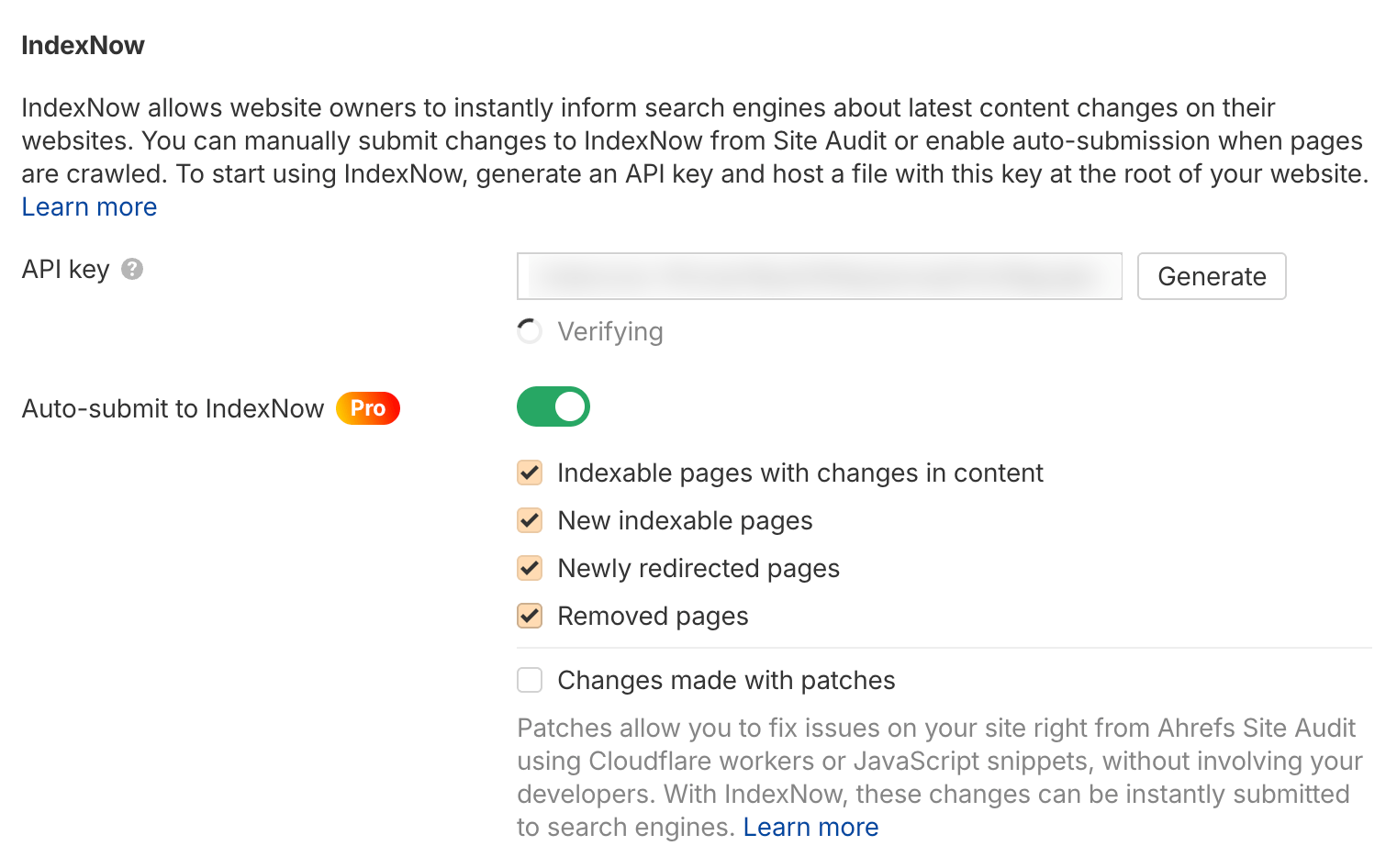
IndexNow notifies Bing and a few other search engines (not Google, though) immediately when you update content. Since ChatGPT uses Bing’s index, this can accelerate your AI visibility after updates.
You can set it up straight from Site Audit’s project settings:
Further reading
Ahrefs’ Rank Tracker.
Your organic traffic grows
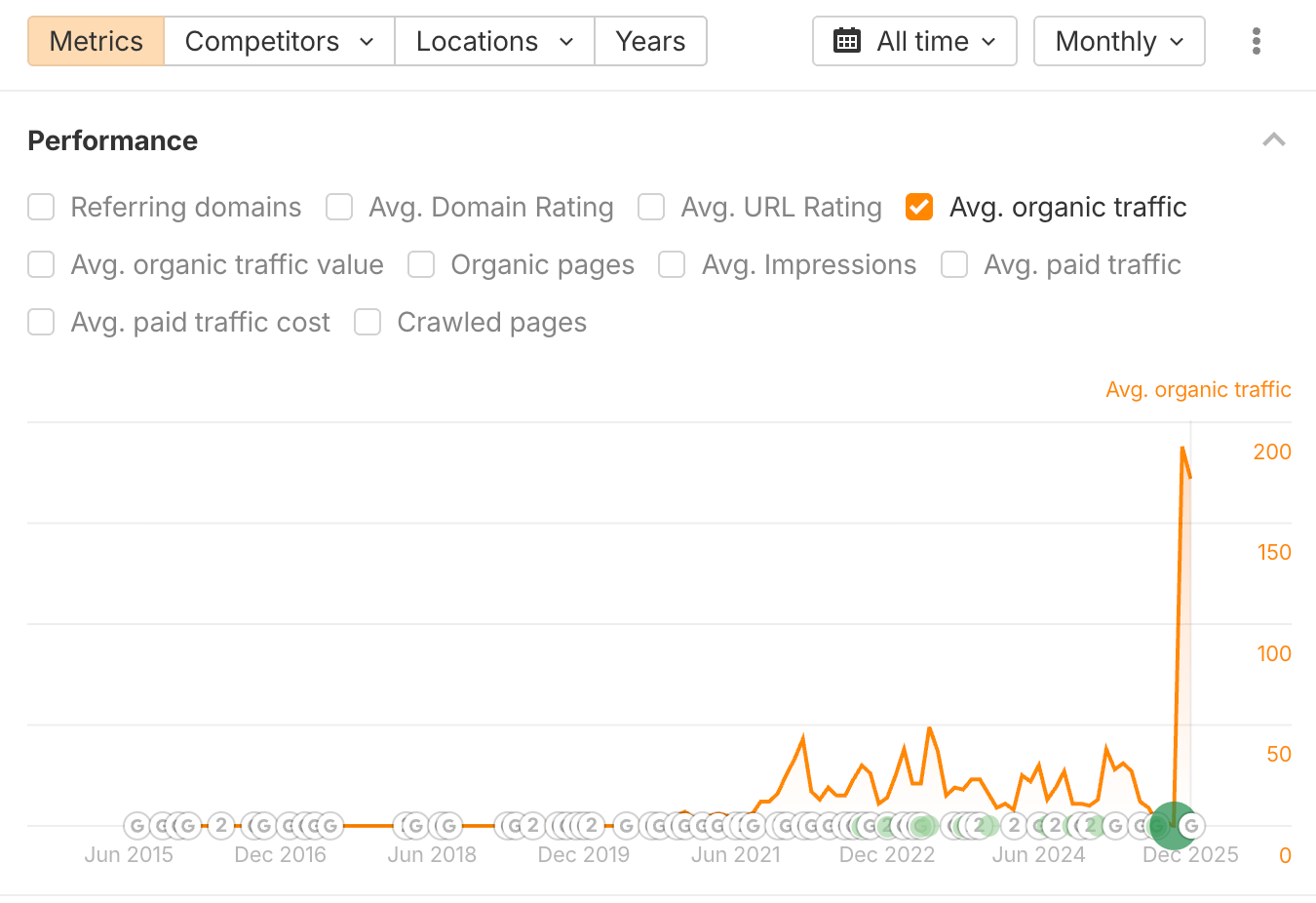
Updating your content can help you rank for new keywords and, as a result, bring in more traffic. Fresh content often captures additional long-tail variations and related queries that weren’t ranking before. You can use the content changes feature in Ahrefs’ Site Explorer to more easily track and report on the impact of those updates.
In the example below, you can clearly see how a content update (marked by the large green dot) led to a spike in traffic (shown in orange).
Your AI citation count increases
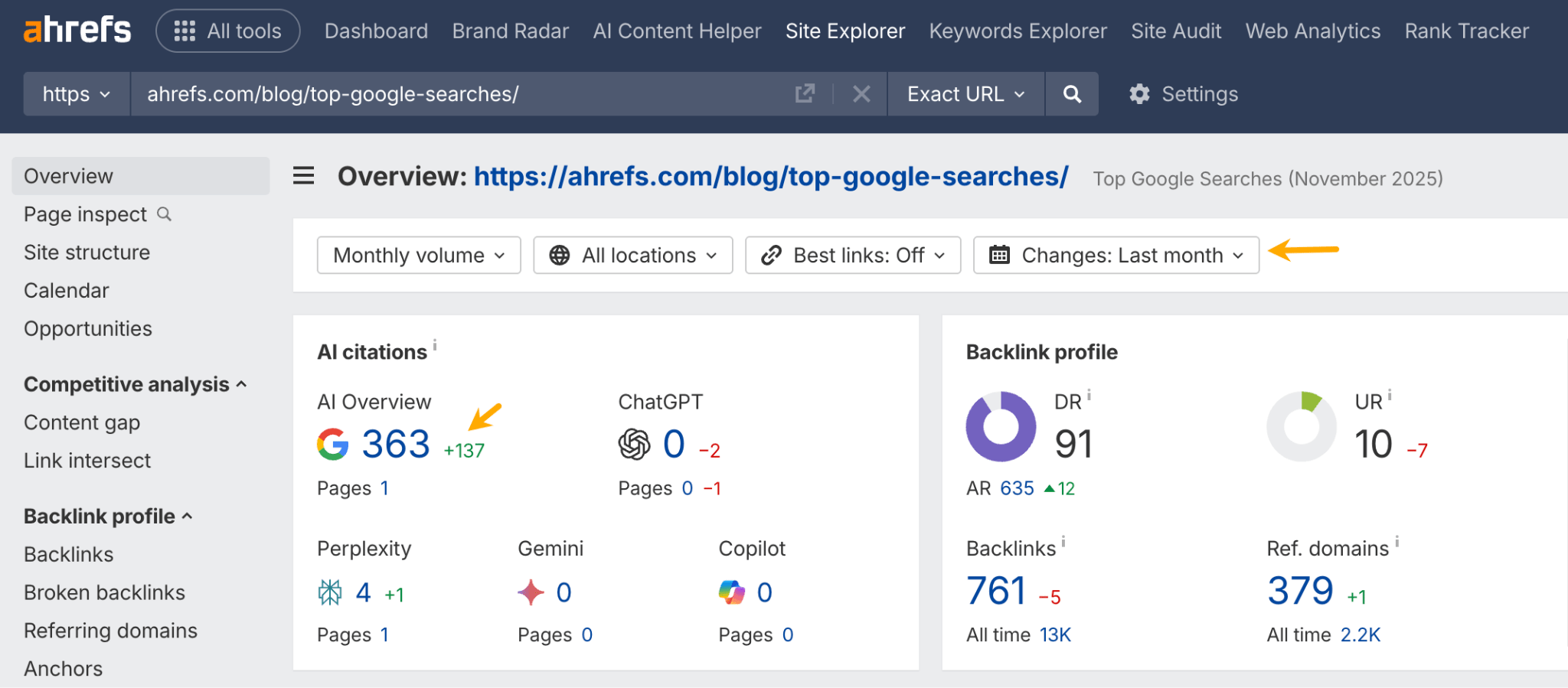
Adding a fresh date to your page and improving its ranking in search results can make it easier for AI bots to discover your content. This increases your chances of being cited, meaning your links may appear in AI-generated answers when users ask related questions.
You can check it in seconds by entering the page’s URL in Ahrefs’ Site Explorer.
Your click-through rate improves
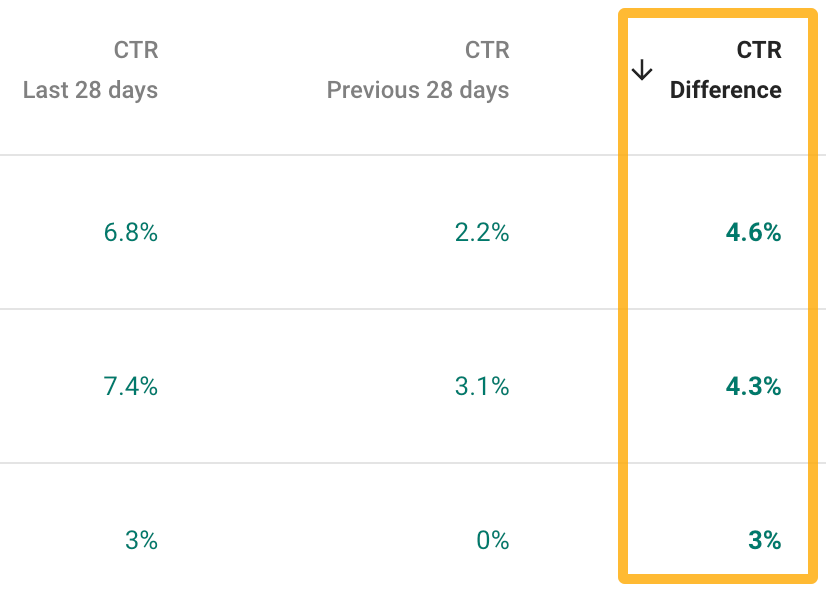
Fresh titles and updated meta descriptions naturally attract more clicks from search results. You can measure how your updates affect click-through rate using Google Search Console—look for improvements in CTR for pages you’ve recently refreshed compared to their pre-update performance.
Similar Posts

You DON’T own crypto on exchanges!
Are crypto exchanges safe? Only if you don’t want to truly own your crypto. There’s only one…

9 Digital Marketing Conferences We’re Attending in 2025
It’s impossible for anyone to list all the best digital marketing conferences as nobody’s been to them all….
Update: AI Overviews Reduce Clicks by 58%
Back in April 2025, we found that AI Overviews reduced clicks to top-ranking content by 34.5%, despite…
Crypto Exchanges Caught Selling Your Data to SCAMMERS!
Here are the best cold wallet deals: Tangem Limited Edition Cards (Sun Drop, Ramen Cat, Bitcoin)10% OFF…

How to Choose the BEST Cold Wallet for 2026
Here are the 3 cold wallets I mentioned: Tangem (Get 10% OFF) : https://cyberscrilla.short.gy/DupmKUUser Guide: https://youtu.be/LdlmHR120e8?si=HHiPYKyvo2xOl2yl Ledger…
WooCommerce 10.8: Stable, faster, and ready for WordPress 7.0
WooCommerce 10.8 includes compatibility updates, performance improvements, and a handful of small fixes that shoppers will feel…
Certain search queries semantically signal the need for fresh content—terms like “new iPhone,” “latest news,” or “2025 trends” make it clear users want current information. But for others, the QDF algorithm looks for three signals that a topic is “hot”:
- News sites are actively writing about it.
- Blog posts are covering it frequently.
- Search volume is spiking.
When all three occur, Google prioritizes fresh content to give searchers the most current information.
According to Google’s documentation, a SERP may gain or lose this feature based on the circumstances.
Fresh content gets higher click-through rates
Users naturally prefer recent content. An outdated title like “Best CRM Tools 2023” gets fewer clicks than “Best CRM Tools 2025”—even at the same ranking position—because users assume older content contains obsolete information or outdated recommendations.
Research shows Google uses click-through rate when re-ranking content. Lower clicks from stale titles create a downward ranking spiral over time.
Fresh content prevents ranking decay
Even when QDF isn’t triggered, Google favors pages that show active maintenance signals.
For example, my content marketing statistics article gains more traffic and gets a boost in referring domains each time it’s updated, but requires regular refreshes to maintain performance.
Fresh content increases your chances for AI citations
AI assistants cite significantly fresher content than traditional search results. Ahrefs’ study analyzing 17 million citations found that AI-cited content is 25.7% fresher than organic Google results.
Breaking it down by platform:
- ChatGPT shows the strongest preference for new content, citing URLs that are 393-458 days newer than organic Google results.
- Perplexity and Gemini also favor fresher content.
- Google’s AI Overviews behave most like traditional search, actually citing content that’s slightly older than what ChatGPT prefers.
Ahrefs’ Webmaster Tools (a free toolkit that gives you access to Site Audit and other features) or Screaming Frog. You’ll just need two things: the date format the site uses in its code, and the regex pattern to match it. Let’s start by finding the code.
Open any blog post on your site that you’ve updated. Then open Inspect (Developer Tools) and, in the search bar, type “publish”.
Write down the properties that hold the published date/time and the last updated date/time.
Now you’ll need two regex patterns. You can adjust the dates as needed and add the codes you found earlier—just ask any AI assistant to help you with that.
Here’s the regex to find content that has never been updated since publication:
<meta[^>]*property=["']article:published_time["'][^>]*content=["'](?:20(?:0d|1d|2[0-4])-d{2}-d{2}|2025-(?:0[1-5])-d{2})T
And this regex is to find content last updated before a certain date:
<meta[^>]*property=["']article:modified_time["'][^>]*content=["'](?:20(?:0d|1d|2[0-4])-d{2}-d{2}|2025-(?:0[1-5])-d{2})T
Combine these filters like this (I’m using Site Audit here, included in Ahrefs Webmaster Tools):
You can also include referring domains to help you prioritize pages that already have some authority, so updates are more likely to show results faster.
Recommendation
To automate this even further, you can enhance the data with traffic opportunity gap insights using the Ahrefs API or MCP.
You can also “guess” each page’s main keyword by pulling it from the URL structure. It’s not perfect, but it works well at scale.
Ask your favorite AI assistant to build a small Python app to handle this. Here’s a sample prompt you can use:
Create a Python script that analyzes content performance and identifies articles that need updating based on their traffic gap.
Requirements:
The script should:
1. Accept a list of URLs as input (either from a CSV file or as a list in the code)
2. For each URL:
- Extract the target keyword from the last segment of the URL slug (the part after the final slash, removing hyphens and converting to a search-friendly format)
- Use the Ahrefs API to fetch the page's current estimated organic traffic
- Use the Ahrefs API to fetch the global search volume for the extracted keyword
- Calculate the "traffic gap" = (Global Search Volume - Current Organic Traffic)
3. Output a prioritized list showing:
- URL
- Extracted keyword
- Current organic traffic
- Global search volume
- Traffic gap
- Priority ranking (sorted by largest gap first)
4. Export results to a CSV file with all the above columns
Technical specifications:
- Use the Ahrefs API endpoints for:
- site-explorer/organic-keywords or site-explorer/metrics to get organic traffic for each URL
- keywords-explorer/overview to get global search volume for keywords
- Refer to the Ahrefs API documentation for endpoint details and parameters: https://docs.ahrefs.com/docs/api/reference/introduction
- Handle API rate limiting appropriately
- Include error handling for URLs that don't return data
- The keyword extraction should handle common URL patterns (removing hyphens, handling special characters)
Please provide well-commented code with clear variable names and include instructions for setting up the Ahrefs API credentials.
Ahrefs’ AI Content Helper. It uses AI to spot topical gaps automatically, showing which topics you’re missing and scoring your coverage against the pages that rank at the top.
Swap stale stats for current data
Old statistics undermine your credibility and can signal to search engines that your content is outdated.
- Replace outdated statistics with recent ones. Add new ones that add something to the topic.
- Update pricing information.
- Add “as of [Month Year]” to key facts.
- Link to recent, authoritative sources instead of outdated ones.
That’s exactly what my colleagues and I do with our curated statistics articles (page comparison via Ahrefs’ Site Explorer):
Refresh product details to boost user engagement
I’d say this tip is mainly about improving click-through rates and on-page user signals. You can apply it alongside other improvements, or even use it to refresh content that’s already ranking in the top 10 by highlighting new updates or features in your product.
- Replace screenshots showing old interfaces.
- Cover recent developments in your topic.
- Remove discontinued products or services.
- Address new objections or concerns that have emerged.
Target seasonal freshness windows
For recurring topics like the ones below, update 3 months before peak season:
- “Black Friday deals”. Update August/September.
- “Tax tips”. Update November/December.
- “Summer destinations”. Update January/February.
Google’s QDF algorithm anticipates these search patterns and favors content that is updated at the right time. For example, pages ranking at the top for “summer holiday” in December 2025 were last updated in early 2025 to target early planners, and again around July 2025 to reach late planners. After summer, those pages typically aren’t updated again for the rest of the year.
As you can see below in the search volume history for the keyword (via Keywords Explorer), this content creation pattern closely follows when interest in the topic rises.
Promote your refresh to earn fresh backlinks and more visitors
You don’t have to stop at republishing the content. You can also promote it on social media, support it with paid ads, or repurpose it into a webinar or other formats. This increases your chances of earning backlinks and attracting more traffic and new visitors.
This is exactly what my colleague Louise did with a content refresh, gaining not only more traffic but also new referring domains and viewers through a webinar on YouTube.
Signal freshness where it counts
Make your updates visible to both users and search engines:
- Add “Last Updated: [Date]” at the very top
- Update the year in your title if appropriate: “Best Project Management Tools 2025”
- Change dateModified in your schema markup
- Consider adding a brief note explaining what was updated and why
Add internal links while you’re updating
Content refreshes are the perfect time to strengthen your internal linking. Use Site Audit’s Internal link opportunities tool to find relevant pages on your site that should link to the content you’re updating. The tool takes the top 10 keywords (by traffic) for each crawled page, then looks for mentions of those on your other crawled pages.
This helps distribute authority and makes it easier for users to discover related content.
Use IndexNow for instant indexing
IndexNow notifies Bing and a few other search engines (not Google, though) immediately when you update content. Since ChatGPT uses Bing’s index, this can accelerate your AI visibility after updates.
You can set it up straight from Site Audit’s project settings:
Further reading
Ahrefs’ Rank Tracker.
Your organic traffic grows
Updating your content can help you rank for new keywords and, as a result, bring in more traffic. Fresh content often captures additional long-tail variations and related queries that weren’t ranking before. You can use the content changes feature in Ahrefs’ Site Explorer to more easily track and report on the impact of those updates.
In the example below, you can clearly see how a content update (marked by the large green dot) led to a spike in traffic (shown in orange).
Your AI citation count increases
Adding a fresh date to your page and improving its ranking in search results can make it easier for AI bots to discover your content. This increases your chances of being cited, meaning your links may appear in AI-generated answers when users ask related questions.
You can check it in seconds by entering the page’s URL in Ahrefs’ Site Explorer.
Your click-through rate improves
Fresh titles and updated meta descriptions naturally attract more clicks from search results. You can measure how your updates affect click-through rate using Google Search Console—look for improvements in CTR for pages you’ve recently refreshed compared to their pre-update performance.
Similar Posts
You DON’T own crypto on exchanges!
Are crypto exchanges safe? Only if you don’t want to truly own your crypto. There’s only one…
9 Digital Marketing Conferences We’re Attending in 2025
It’s impossible for anyone to list all the best digital marketing conferences as nobody’s been to them all….
Update: AI Overviews Reduce Clicks by 58%
Back in April 2025, we found that AI Overviews reduced clicks to top-ranking content by 34.5%, despite…
Crypto Exchanges Caught Selling Your Data to SCAMMERS!
Here are the best cold wallet deals: Tangem Limited Edition Cards (Sun Drop, Ramen Cat, Bitcoin)10% OFF…
How to Choose the BEST Cold Wallet for 2026
Here are the 3 cold wallets I mentioned: Tangem (Get 10% OFF) : https://cyberscrilla.short.gy/DupmKUUser Guide: https://youtu.be/LdlmHR120e8?si=HHiPYKyvo2xOl2yl Ledger…
WooCommerce 10.8: Stable, faster, and ready for WordPress 7.0
WooCommerce 10.8 includes compatibility updates, performance improvements, and a handful of small fixes that shoppers will feel…
Open any blog post on your site that you’ve updated. Then open Inspect (Developer Tools) and, in the search bar, type “publish”.
Write down the properties that hold the published date/time and the last updated date/time.
Now you’ll need two regex patterns. You can adjust the dates as needed and add the codes you found earlier—just ask any AI assistant to help you with that.
Here’s the regex to find content that has never been updated since publication:
<meta[^>]*property=["']article:published_time["'][^>]*content=["'](?:20(?:0d|1d|2[0-4])-d{2}-d{2}|2025-(?:0[1-5])-d{2})TAnd this regex is to find content last updated before a certain date:
<meta[^>]*property=["']article:modified_time["'][^>]*content=["'](?:20(?:0d|1d|2[0-4])-d{2}-d{2}|2025-(?:0[1-5])-d{2})TCombine these filters like this (I’m using Site Audit here, included in Ahrefs Webmaster Tools):
You can also include referring domains to help you prioritize pages that already have some authority, so updates are more likely to show results faster.
Recommendation
To automate this even further, you can enhance the data with traffic opportunity gap insights using the Ahrefs API or MCP.
You can also “guess” each page’s main keyword by pulling it from the URL structure. It’s not perfect, but it works well at scale.
Ask your favorite AI assistant to build a small Python app to handle this. Here’s a sample prompt you can use:
Create a Python script that analyzes content performance and identifies articles that need updating based on their traffic gap.
Requirements:
The script should:
1. Accept a list of URLs as input (either from a CSV file or as a list in the code)
2. For each URL:
- Extract the target keyword from the last segment of the URL slug (the part after the final slash, removing hyphens and converting to a search-friendly format)
- Use the Ahrefs API to fetch the page's current estimated organic traffic
- Use the Ahrefs API to fetch the global search volume for the extracted keyword
- Calculate the "traffic gap" = (Global Search Volume - Current Organic Traffic)
3. Output a prioritized list showing:
- URL
- Extracted keyword
- Current organic traffic
- Global search volume
- Traffic gap
- Priority ranking (sorted by largest gap first)
4. Export results to a CSV file with all the above columns
Technical specifications:
- Use the Ahrefs API endpoints for:
- site-explorer/organic-keywords or site-explorer/metrics to get organic traffic for each URL
- keywords-explorer/overview to get global search volume for keywords
- Refer to the Ahrefs API documentation for endpoint details and parameters: https://docs.ahrefs.com/docs/api/reference/introduction
- Handle API rate limiting appropriately
- Include error handling for URLs that don't return data
- The keyword extraction should handle common URL patterns (removing hyphens, handling special characters)
Please provide well-commented code with clear variable names and include instructions for setting up the Ahrefs API credentials.
Ahrefs’ AI Content Helper. It uses AI to spot topical gaps automatically, showing which topics you’re missing and scoring your coverage against the pages that rank at the top.
Swap stale stats for current data
Old statistics undermine your credibility and can signal to search engines that your content is outdated.
- Replace outdated statistics with recent ones. Add new ones that add something to the topic.
- Update pricing information.
- Add “as of [Month Year]” to key facts.
- Link to recent, authoritative sources instead of outdated ones.
That’s exactly what my colleagues and I do with our curated statistics articles (page comparison via Ahrefs’ Site Explorer):
Refresh product details to boost user engagement
I’d say this tip is mainly about improving click-through rates and on-page user signals. You can apply it alongside other improvements, or even use it to refresh content that’s already ranking in the top 10 by highlighting new updates or features in your product.
- Replace screenshots showing old interfaces.
- Cover recent developments in your topic.
- Remove discontinued products or services.
- Address new objections or concerns that have emerged.
Target seasonal freshness windows
For recurring topics like the ones below, update 3 months before peak season:
- “Black Friday deals”. Update August/September.
- “Tax tips”. Update November/December.
- “Summer destinations”. Update January/February.
Google’s QDF algorithm anticipates these search patterns and favors content that is updated at the right time. For example, pages ranking at the top for “summer holiday” in December 2025 were last updated in early 2025 to target early planners, and again around July 2025 to reach late planners. After summer, those pages typically aren’t updated again for the rest of the year.
As you can see below in the search volume history for the keyword (via Keywords Explorer), this content creation pattern closely follows when interest in the topic rises.
Promote your refresh to earn fresh backlinks and more visitors
You don’t have to stop at republishing the content. You can also promote it on social media, support it with paid ads, or repurpose it into a webinar or other formats. This increases your chances of earning backlinks and attracting more traffic and new visitors.
This is exactly what my colleague Louise did with a content refresh, gaining not only more traffic but also new referring domains and viewers through a webinar on YouTube.
Signal freshness where it counts
Make your updates visible to both users and search engines:
- Add “Last Updated: [Date]” at the very top
- Update the year in your title if appropriate: “Best Project Management Tools 2025”
- Change dateModified in your schema markup
- Consider adding a brief note explaining what was updated and why
Add internal links while you’re updating
Content refreshes are the perfect time to strengthen your internal linking. Use Site Audit’s Internal link opportunities tool to find relevant pages on your site that should link to the content you’re updating. The tool takes the top 10 keywords (by traffic) for each crawled page, then looks for mentions of those on your other crawled pages.
This helps distribute authority and makes it easier for users to discover related content.
Use IndexNow for instant indexing
IndexNow notifies Bing and a few other search engines (not Google, though) immediately when you update content. Since ChatGPT uses Bing’s index, this can accelerate your AI visibility after updates.
You can set it up straight from Site Audit’s project settings:
Further reading
Ahrefs’ Rank Tracker.
Your organic traffic grows
Updating your content can help you rank for new keywords and, as a result, bring in more traffic. Fresh content often captures additional long-tail variations and related queries that weren’t ranking before. You can use the content changes feature in Ahrefs’ Site Explorer to more easily track and report on the impact of those updates.
In the example below, you can clearly see how a content update (marked by the large green dot) led to a spike in traffic (shown in orange).
Your AI citation count increases
Adding a fresh date to your page and improving its ranking in search results can make it easier for AI bots to discover your content. This increases your chances of being cited, meaning your links may appear in AI-generated answers when users ask related questions.
You can check it in seconds by entering the page’s URL in Ahrefs’ Site Explorer.
Your click-through rate improves
Fresh titles and updated meta descriptions naturally attract more clicks from search results. You can measure how your updates affect click-through rate using Google Search Console—look for improvements in CTR for pages you’ve recently refreshed compared to their pre-update performance.
Similar Posts
You DON’T own crypto on exchanges!
Are crypto exchanges safe? Only if you don’t want to truly own your crypto. There’s only one…
9 Digital Marketing Conferences We’re Attending in 2025
It’s impossible for anyone to list all the best digital marketing conferences as nobody’s been to them all….
Update: AI Overviews Reduce Clicks by 58%
Back in April 2025, we found that AI Overviews reduced clicks to top-ranking content by 34.5%, despite…
Crypto Exchanges Caught Selling Your Data to SCAMMERS!
Here are the best cold wallet deals: Tangem Limited Edition Cards (Sun Drop, Ramen Cat, Bitcoin)10% OFF…
How to Choose the BEST Cold Wallet for 2026
Here are the 3 cold wallets I mentioned: Tangem (Get 10% OFF) : https://cyberscrilla.short.gy/DupmKUUser Guide: https://youtu.be/LdlmHR120e8?si=HHiPYKyvo2xOl2yl Ledger…
WooCommerce 10.8: Stable, faster, and ready for WordPress 7.0
WooCommerce 10.8 includes compatibility updates, performance improvements, and a handful of small fixes that shoppers will feel…
Swap stale stats for current data
Old statistics undermine your credibility and can signal to search engines that your content is outdated.
- Replace outdated statistics with recent ones. Add new ones that add something to the topic.
- Update pricing information.
- Add “as of [Month Year]” to key facts.
- Link to recent, authoritative sources instead of outdated ones.
That’s exactly what my colleagues and I do with our curated statistics articles (page comparison via Ahrefs’ Site Explorer):
Refresh product details to boost user engagement
I’d say this tip is mainly about improving click-through rates and on-page user signals. You can apply it alongside other improvements, or even use it to refresh content that’s already ranking in the top 10 by highlighting new updates or features in your product.
- Replace screenshots showing old interfaces.
- Cover recent developments in your topic.
- Remove discontinued products or services.
- Address new objections or concerns that have emerged.
Target seasonal freshness windows
For recurring topics like the ones below, update 3 months before peak season:
- “Black Friday deals”. Update August/September.
- “Tax tips”. Update November/December.
- “Summer destinations”. Update January/February.
Google’s QDF algorithm anticipates these search patterns and favors content that is updated at the right time. For example, pages ranking at the top for “summer holiday” in December 2025 were last updated in early 2025 to target early planners, and again around July 2025 to reach late planners. After summer, those pages typically aren’t updated again for the rest of the year.
As you can see below in the search volume history for the keyword (via Keywords Explorer), this content creation pattern closely follows when interest in the topic rises.
Promote your refresh to earn fresh backlinks and more visitors
You don’t have to stop at republishing the content. You can also promote it on social media, support it with paid ads, or repurpose it into a webinar or other formats. This increases your chances of earning backlinks and attracting more traffic and new visitors.
This is exactly what my colleague Louise did with a content refresh, gaining not only more traffic but also new referring domains and viewers through a webinar on YouTube.
Signal freshness where it counts
Make your updates visible to both users and search engines:
- Add “Last Updated: [Date]” at the very top
- Update the year in your title if appropriate: “Best Project Management Tools 2025”
- Change dateModified in your schema markup
- Consider adding a brief note explaining what was updated and why
Add internal links while you’re updating
Content refreshes are the perfect time to strengthen your internal linking. Use Site Audit’s Internal link opportunities tool to find relevant pages on your site that should link to the content you’re updating. The tool takes the top 10 keywords (by traffic) for each crawled page, then looks for mentions of those on your other crawled pages.
This helps distribute authority and makes it easier for users to discover related content.
Use IndexNow for instant indexing
IndexNow notifies Bing and a few other search engines (not Google, though) immediately when you update content. Since ChatGPT uses Bing’s index, this can accelerate your AI visibility after updates.
You can set it up straight from Site Audit’s project settings:
Further reading
Ahrefs’ Rank Tracker.
Your organic traffic grows
Updating your content can help you rank for new keywords and, as a result, bring in more traffic. Fresh content often captures additional long-tail variations and related queries that weren’t ranking before. You can use the content changes feature in Ahrefs’ Site Explorer to more easily track and report on the impact of those updates.
In the example below, you can clearly see how a content update (marked by the large green dot) led to a spike in traffic (shown in orange).
Your AI citation count increases
Adding a fresh date to your page and improving its ranking in search results can make it easier for AI bots to discover your content. This increases your chances of being cited, meaning your links may appear in AI-generated answers when users ask related questions.
You can check it in seconds by entering the page’s URL in Ahrefs’ Site Explorer.
Your click-through rate improves
Fresh titles and updated meta descriptions naturally attract more clicks from search results. You can measure how your updates affect click-through rate using Google Search Console—look for improvements in CTR for pages you’ve recently refreshed compared to their pre-update performance.
Similar Posts
You DON’T own crypto on exchanges!
Are crypto exchanges safe? Only if you don’t want to truly own your crypto. There’s only one…
9 Digital Marketing Conferences We’re Attending in 2025
It’s impossible for anyone to list all the best digital marketing conferences as nobody’s been to them all….
Update: AI Overviews Reduce Clicks by 58%
Back in April 2025, we found that AI Overviews reduced clicks to top-ranking content by 34.5%, despite…
Crypto Exchanges Caught Selling Your Data to SCAMMERS!
Here are the best cold wallet deals: Tangem Limited Edition Cards (Sun Drop, Ramen Cat, Bitcoin)10% OFF…
How to Choose the BEST Cold Wallet for 2026
Here are the 3 cold wallets I mentioned: Tangem (Get 10% OFF) : https://cyberscrilla.short.gy/DupmKUUser Guide: https://youtu.be/LdlmHR120e8?si=HHiPYKyvo2xOl2yl Ledger…
WooCommerce 10.8: Stable, faster, and ready for WordPress 7.0
WooCommerce 10.8 includes compatibility updates, performance improvements, and a handful of small fixes that shoppers will feel…
Your organic traffic grows
Updating your content can help you rank for new keywords and, as a result, bring in more traffic. Fresh content often captures additional long-tail variations and related queries that weren’t ranking before. You can use the content changes feature in Ahrefs’ Site Explorer to more easily track and report on the impact of those updates.
In the example below, you can clearly see how a content update (marked by the large green dot) led to a spike in traffic (shown in orange).
Your AI citation count increases
Adding a fresh date to your page and improving its ranking in search results can make it easier for AI bots to discover your content. This increases your chances of being cited, meaning your links may appear in AI-generated answers when users ask related questions.
You can check it in seconds by entering the page’s URL in Ahrefs’ Site Explorer.
Your click-through rate improves
Fresh titles and updated meta descriptions naturally attract more clicks from search results. You can measure how your updates affect click-through rate using Google Search Console—look for improvements in CTR for pages you’ve recently refreshed compared to their pre-update performance.
Similar Posts
You DON’T own crypto on exchanges!
Are crypto exchanges safe? Only if you don’t want to truly own your crypto. There’s only one…
9 Digital Marketing Conferences We’re Attending in 2025
It’s impossible for anyone to list all the best digital marketing conferences as nobody’s been to them all….
Update: AI Overviews Reduce Clicks by 58%
Back in April 2025, we found that AI Overviews reduced clicks to top-ranking content by 34.5%, despite…
Crypto Exchanges Caught Selling Your Data to SCAMMERS!
Here are the best cold wallet deals: Tangem Limited Edition Cards (Sun Drop, Ramen Cat, Bitcoin)10% OFF…
How to Choose the BEST Cold Wallet for 2026
Here are the 3 cold wallets I mentioned: Tangem (Get 10% OFF) : https://cyberscrilla.short.gy/DupmKUUser Guide: https://youtu.be/LdlmHR120e8?si=HHiPYKyvo2xOl2yl Ledger…
WooCommerce 10.8: Stable, faster, and ready for WordPress 7.0
WooCommerce 10.8 includes compatibility updates, performance improvements, and a handful of small fixes that shoppers will feel…