AI assistants are now a discovery channel. People who used to type a query into Google now have the option to ask ChatGPT, Claude, Gemini, Perplexity, or Copilot instead. And the answer they get back names a few brands, cites a few sources, and moves on.
If you’re one of the named brands, you win. If you’re not, you never knew the conversation happened.
Optimizing for that is called AEO (or if you prefer, GEO.) This is now part of SEO and/or the marketing team’s responsibility.
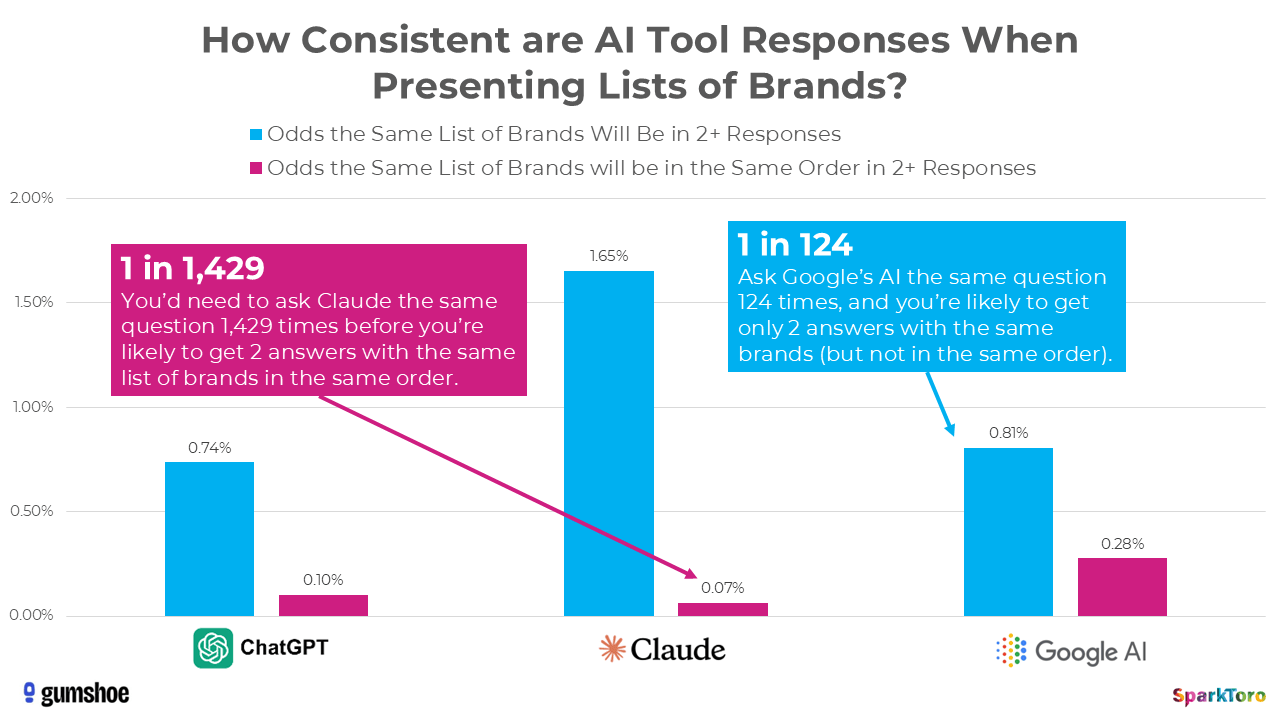
The unfortunate problem is that it’s relentless. The answers shift weekly if not daily. The answers vary by model, by country, by phrasing. In fact, the same prompt generates different brands in different lists all the time.
AI assistants are highly inconsistent when it comes to recommending brands or products. Recommendations change every time you ask the same question.
A competitor you’ve never heard of could start getting cited and you only find out a month later. Or somewhere in a Reddit thread that an LLM keeps quoting, your pricing is wrong.
None of this trips an alarm. But you need someone checking, on a schedule, regularly. It doesn’t have to be you. It just needs to ping you when something’s worth your attention.
This is the part of AEO you can hand to Letaido.
Here are some of the best use cases you can get started with.
What is Letaido?
Letaido is a marketing agent from Ahrefs—an AI assistant with direct access to the full Ahrefs dataset that can carry out marketing tasks autonomously, rather than just answer questions.
Letaido includes:
Unrestricted access to Ahrefs endpoints. Every endpoint we use to build Ahrefs is available, including many you cannot reach via API or MCP.
Serious tech stack underneath. Postgres for state, Flask for UIs, an OpenRouter proxy with 300+ models, web fetch with full-page parsing, PDFs, OCR, scheduled jobs.
Native connectors to marketing tools. Slack, HubSpot, GitHub, Notion, Linear, Mailchimp, Resend, SendGrid, Stripe, Gong, WordPress, Airtable, Apify, and even Semrush.
Expert skill library. The Ahrefs team has contributed pre-built marketing skills and applications that encode how we actually work.
1. Discover the prompts worth winning
When you do keyword research, your goal is to find what people typed into Google’s search box.
AEO is the same-same-but-different job: you’re trying to figure out which prompts and questions people now put to an assistant, and which ones are worth winning.
Unfortunately, you can’t measure prompt volume directly. But you can estimate it.
Here’s how:
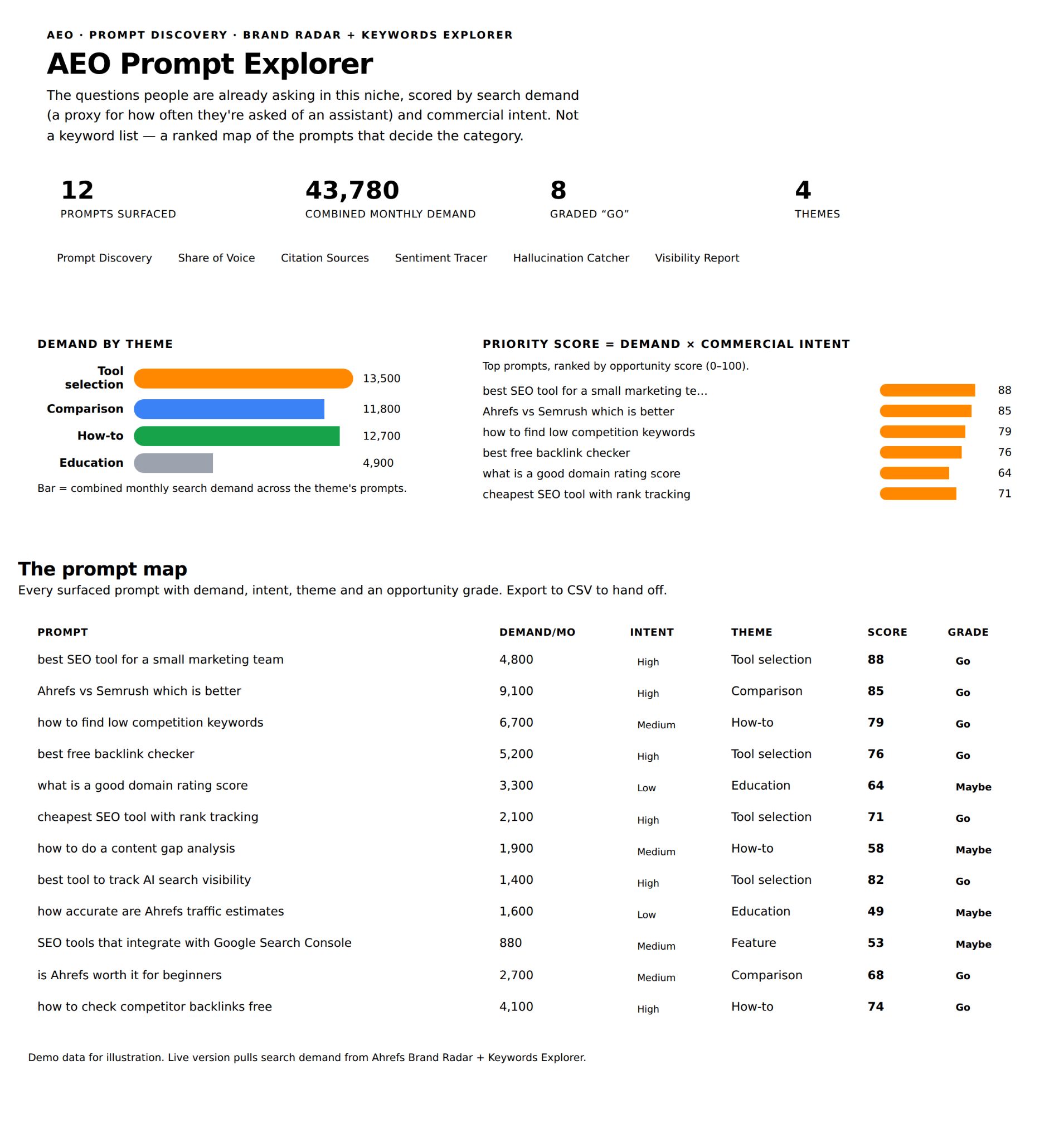
Give Letaido a few seed topics and it uses Brand Radar to surface the real prompts and questions people ask in your niche, then pulls the search demand behind each one as a proxy for how often it’s asked.
Since raw search volume overstates prompt demand (because fewer people use each AI assistant than Google), Letaido scales each prompt’s demand by the assistant’s user base relative to Google Search.
For example, if ChatGPT has roughly 30% of Google’s users, a prompt’s Google volume is weighted by ~0.3 to reflect its real AI demand.
What comes back is a prioritized map of prompts, ranked by the search demand behind each one (a rough proxy) and how commercial the intent is.
You end up with a shortlist of the prompts that actually matter in your space, instead of guessing.
Starter prompt
Build me an AEO prompt-discovery tool. Input: a few seed topics. (1) Use Ahrefs Brand Radar to surface the real questions people ask in this niche and pull their search demand; (2) cross-check volume and intent against Keywords Explorer; (3) score each prompt by search demand (as a proxy for prompt demand) × commercial intent; (4) cluster the prompts into themes. Output a ranked prompt map in a table I can export, with volume, intent, and theme per prompt.
AI Overviews, AI Mode, and more.
Here’s how to see your real share of voice.
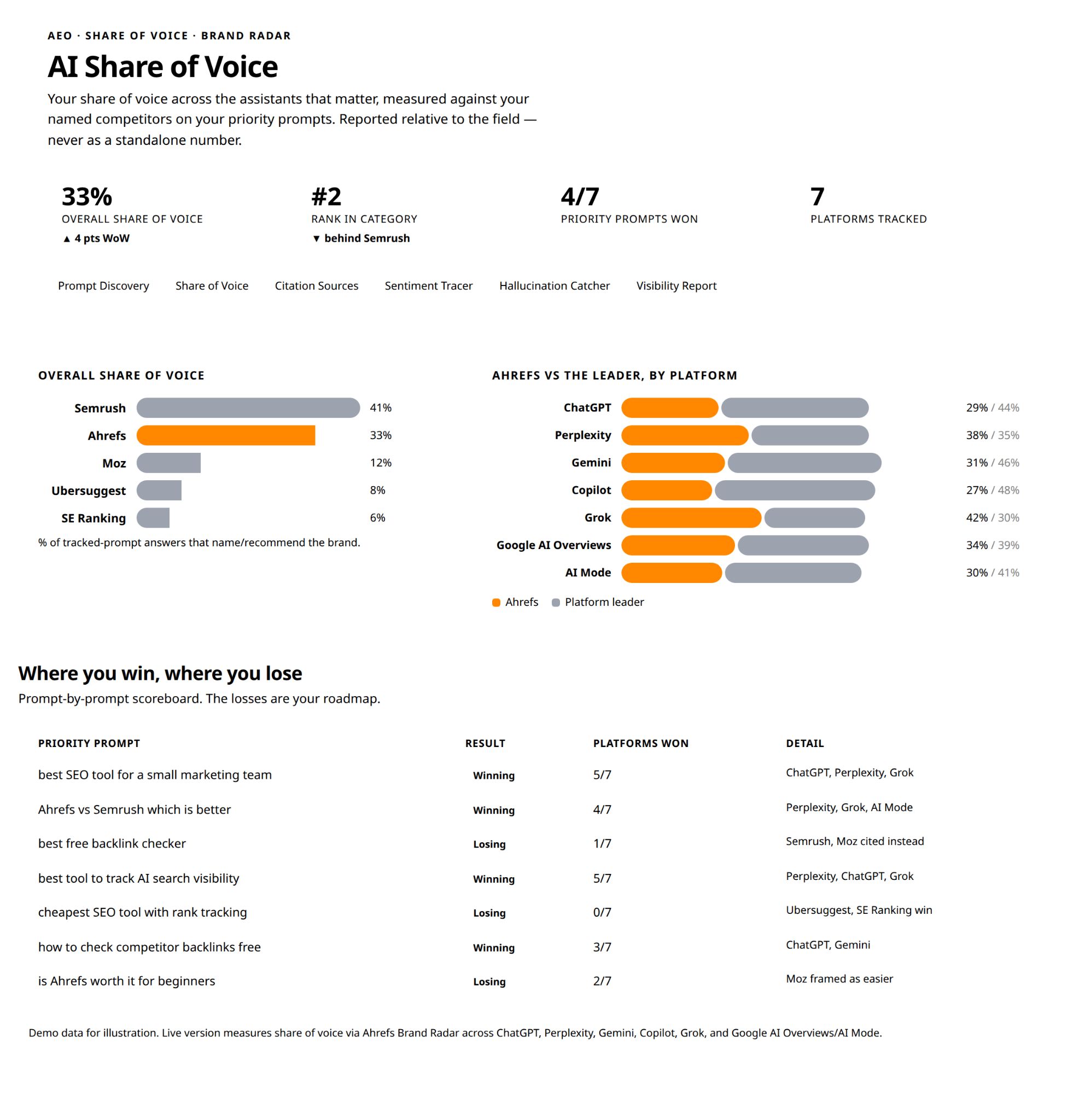
Ask Letaido to measure your real share of voice across the assistants that matter to you (e.g., ChatGPT, Google AI Overviews, AI Mode, Gemini, etc.). It runs your priority prompts through Brand Radar, counts how often each answer mentions or recommends you versus your named competitors, and breaks it down prompt by prompt so you can see exactly which ones you win and which you lose.
The output is a scoreboard: your share of voice per platform, the prompts where you’re absent, and the competitors eating your share.
Starter prompt:
Starter prompt
Build me an AI share-of-voice tracker. For my list of priority prompts and named competitors, use Ahrefs Brand Radar to measure my share of voice across ChatGPT, Perplexity, Gemini, Copilot, Grok, and Google AI Overviews/AI Mode. Break it down per platform and per prompt: where I’m mentioned, where I’m recommended, where I’m absent, and which competitor wins instead. Log the weekly totals so I can track the trend, and only ever show my share relative to my named competitors.
Despina’s guide on auditing brand mentions to learn what to do next.
Starter prompt
Build me a negative-sentiment tracer. Use Ahrefs Brand Radar to pull the full answer text, prompt, and cited sources for every AI mention of my brand across platforms. Run sentiment analysis on each answer, keep the negative ones, and for each: quote the line, name the triggering prompt, and identify the cited source most likely responsible. Log them to Airtable sorted by severity, and re-run weekly so I can watch issues clear as I fix the sources.
try Letaido for free for one month.
Paste a starter prompt into a fresh workspace and you’ll have the first version running today. Then refine and customise it to your desired workflow. You’ll have your personal AEO tools in no time.
🚨 Get 10% OFF your entire Tangem order! This link automatically applies the discount: https://tangem.com/en/pricing/?promocode=CYBERSCRILLA#pricing Don’t like…
Buy 1 Tangem Wallet Get 1 60% off using my link: https://cyberscrilla.short.gy/X3Poh7 Tangem wallet user guide: https://youtu.be/9igpzsN8ldY?si=8yLmZ_auBUPrO6GZ…